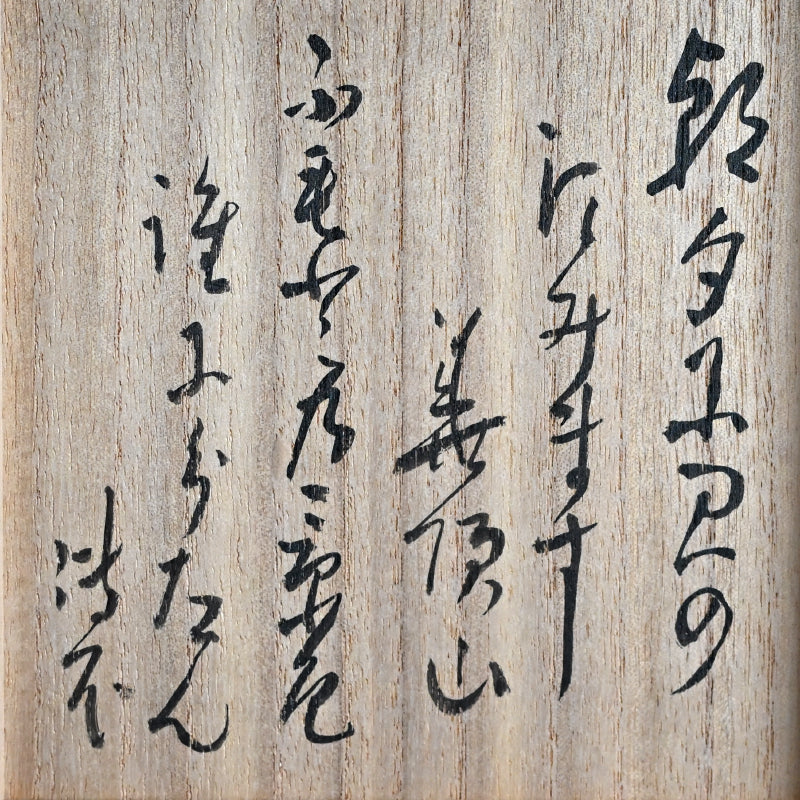
Water passes under the bridge, flowing ever away, like time, no moment ever the same, a poignant image painted by Zen priest Maruyama Denne on this bowl by Eiraku Zengoro XIV (Myozen) enclosed in a period wooden box with a long inscription. It is 12.5 cm (5 inches) diameter, 7 cm (just less than 3 inches) tall and in perfect condition. This seal was used by multiple members of the Eiraku family (12th -14th generations) between the later 19th to early 20th centuries however judging by style and age is the work of Eiraku Myozen, a rare female figure in the ceramic world from the early 20th century.
Maruyama Denne(1871–1940) was a Rinzai Zen monk and the 488th Abbot of Daitoku-ji. He was the Dharma successor of Kōshū, the 483rd Abbot of Daitoku-ji. Invited by the Myōshin-ji branch of the Rinzai school, he served as the 6th Kanchō (Chief Abbot) and as shike (head training master) of its monastic training hall. He opened the training hall in 1924 and passed away in 1940 at the age of 70.
The Eiraku family is one of Japan’s most important and historically significant lines of pottery artists in Kyoto, tracing back to the 16th century. The skill of Eiraku potters earned the honorific title of Senke-Jissoku, reserved for 10 families of artisans who produce tea ceremony utensils for the san-Senke, or Japanese tea schools. Records and information on early generations of the Nishimura family were destroyed in the Tenmei fire (1788). The name Eiraku began being used by the 11th generation Hozen. Eiraku Zengoro XII (Wazen, 1823-1896) was one of the most influential potters of his time, setting the stage for the revival of and modernization of Kyoyaki, based on models by Koetsu, Kenzan and Ninsei. Although named Sentaro, he was more commonly referred to by the name Zengoro, and used also the name Wazen after 1865. He was trained under his father, Hozen, who was a compatriot of Ninnami Dohachi and Aoki Mokubei, and rightfully one of the most famous potters of the later Edo. Wazen was given the reins to the family business quite early, in 1843, and managed the day to day running of the kiln while his father sought to perfect porcelain products in Kyoto. From 1852 to 1865 the family worked from a kiln at Ninnaji temple. Attracting the attention of a Daimyo from Kaga, from 1866-1870 he worked to revitalize a porcelain kiln in that area, coming to produce classic wares which are prized to this day. During this time of working divided from the family kiln, two workers who had been trained by his father shared the title of the 13th generation leader in Kyoto, however Wazen outlived both by decades. He returned to Kyoto in 1870, and also established a kiln in Mikawa in the 1870s to produce more common tableware. From 1882 until his death, it seems he worked from a large kiln in the Eastern Hills of Kyoto. Under both the 11th and 12 generations of this family the name Zengoro took on a life of its own, and came to symbolize the highest in porcelain and tea wares. XIV (Tokuzaen) was born the first son of Eiraku Wazen, the 12th generation head of the family in 1853. Best known for Aka-e and Gosu, with a strong hand, he died in 1909. Eiraku Myozen (1852-1927) was the wife of Eiraku Tokuzen and was a rarely accepted female potter of the Meiji to Early Showa eras, protecting and propelling the name of Eiraku into a new generation. She guided the family through the volatile years of the late Meiji and Taisho eras, and added a delicate touch to the Eiraku oeuvre. Her work was especially favored by 12th generation head of Omote Senkei Seisai. Pieces by her are held in the Seattle Art Museum and Freer Sackler Gallery among others.