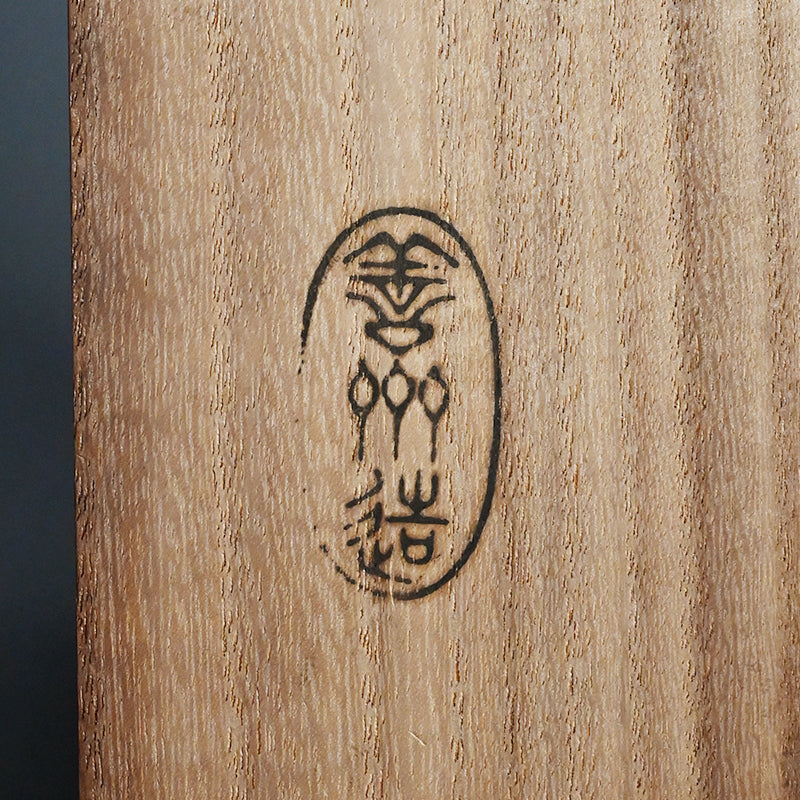
A delicate Shunkei-nuri lacquer box decorated with young pine sprouts by Yamamoto Shunkyo enclosed in the original signed wooden box. On the underside of the lid a pine cone and scattered pine needles accompany the artists signature and Ka-o mark. Inside the box is inset with an inkstone in an unusual shape with a gold lacquered rim, and contains a leaf shaped ceramic suiteki water dropper made by fellow Imperial Artist (Teishitsu Gigei-In) Ito Tozan I. The box is made of light Paulownia (Kiri) wood covered in thin transparent red lacquer allowing the wood grain to be clearly defined. It is 23.5 x 26 x 4 cm (9-1/2 x 10-1/2 x 1-1/2 inches) and is in excellent condition.
Yamamoto Shunkyo (1871–1933) was one of the foremost painters of modern Kyoto active from the Meiji through early Shōwa periods. He was a leading figure of the Maruyama-Shijō tradition, yet distinguished himself by his openness to innovation, incorporating photography and Western pictorial techniques into Japanese painting, particularly in his celebrated landscape works. Born in Zeze, present-day Ōtsu, Shiga Prefecture, he entered the world of painting around the age of twelve after studying Chinese classics in his youth,, becoming a pupil of his distant relative, the painter Nomura Bunkyo, who bestowed upon him the art name Shunkyo. When Bunkyo moved to Tokyo, Shunkyo continued his training under Mori Kansai, one of the great masters of the Maruyama-Shijō school. He quickly demonstrated exceptional talent, winning prizes at exhibitions while still in his teens. In 1891, together with Takeuchi Seihō and Kikuchi Hōbun, he helped revive the Kyoto Young Painters' Association and soon became an influential figure in Kyoto's artistic circles. He exhibited widely both in Japan and abroad, participating in international expositions in Germany, Paris, and Chicago. Following the death of Mori Kansai in 1894, Shunkyo established his own studio in Kyoto and began the independent career that would secure his reputation. In 1899 he was appointed instructor at the Kyoto Municipal School of Arts and Crafts, a predecessor of today's Kyoto City University of Arts. He subsequently served as professor at the Kyoto Municipal School of Painting and trained a generation of important painters. A turning point in his career came in 1904, when he was dispatched to the United States to study design and art education at the Louisiana Purchase Exposition. Although illness prevented him from continuing to Europe, the journey profoundly affected his artistic vision.
Upon his return he produced a series of monochrome mountain landscapes that employed atmospheric perspective in ways unprecedented in Japanese painting. Works such as Snow in the Rockies (Rokkii no Yuki) and Winter Evening demonstrated his successful synthesis of Japanese and Western pictorial ideas and marked a major advance in modern landscape painting. When the government-sponsored Bunten exhibition was established in 1907, Shunkyo was appointed as one of its judges. His stature continued to rise, and in 1917 he was named an Imperial Household Artist (Teishitsu Gigeiin), followed in 1919 by appointment as a member of the Imperial Art Academy. Shunkyo received numerous prestigious commissions from the Imperial Household, including paintings for the investiture ceremony of Crown Prince Hirohito (the future Emperor Shōwa) and screens for Emperor Shōwa's Daijōsai enthronement rites. His works were also admired abroad; in 1926, after donating Snowy Mountain Village to the Musée du Luxembourg in Paris, he was awarded the rank of Chevalier of the French Legion of Honour. During this period he developed a friendship with the French ambassador and poet Paul Claudel. Shunkyo was renowned for his monumental yet lyrical landscapes, which combined grandeur, delicacy, and poetic atmosphere. His brilliant, transparent blue pigments became so distinctive that they are still known today as "Shunkyo Blue," and the precise method by which he achieved this extraordinary color remains a mystery. While firmly rooted in the Maruyama-Shijō tradition of direct observation, his work also absorbed Western approaches to light, perspective, and realism, resulting in a highly personal and modern pictorial language.
Beyond painting, Shunkyo possessed remarkably broad interests. He practiced Zen Buddhism, wrote humorous poetry and haiku, pursued tea ceremony and calligraphy, and was an enthusiastic mountaineer and photographer. Indeed, he was among the first Japanese painters to systematically employ photography in artistic practice, carrying cumbersome photographic equipment on sketching expeditions and using photographs as aids in composition and studies of natural phenomena such as waterfalls and clouds. He became one of the pioneers of photography in Kyoto and served as president of the Kyoto Amateur Photographic Association. Shunkyo was instrumental in the revival of the historic Zeze ware tradition, supporting local potters and helping to reestablish one of Ōtsu's most distinguished ceramic legacies. In 1914 Shunkyo began construction of his lakeside retreat, the Roka Sensuisō, which gradually expanded into a sprawling sukiya-style villa overlooking Lake Biwa. The residence, now designated an Important Cultural Property of Japan, served as a gathering place for artists, aristocrats, and distinguished guests, including Prince Kuni and Paul Claudel. Shunkyo remained active until the end of his life. In March 1933 he exhibited Spring in the Deep Mountains and Aso Plateau, but shortly thereafter fell ill in Kyoto and died on July 12, 1933, at the age of sixty-one. He is held in the collections of numerous museums, including the Kyoto Municipal Museum of Art, Museum of Modern Art Tokyo and Boston Museum among others.