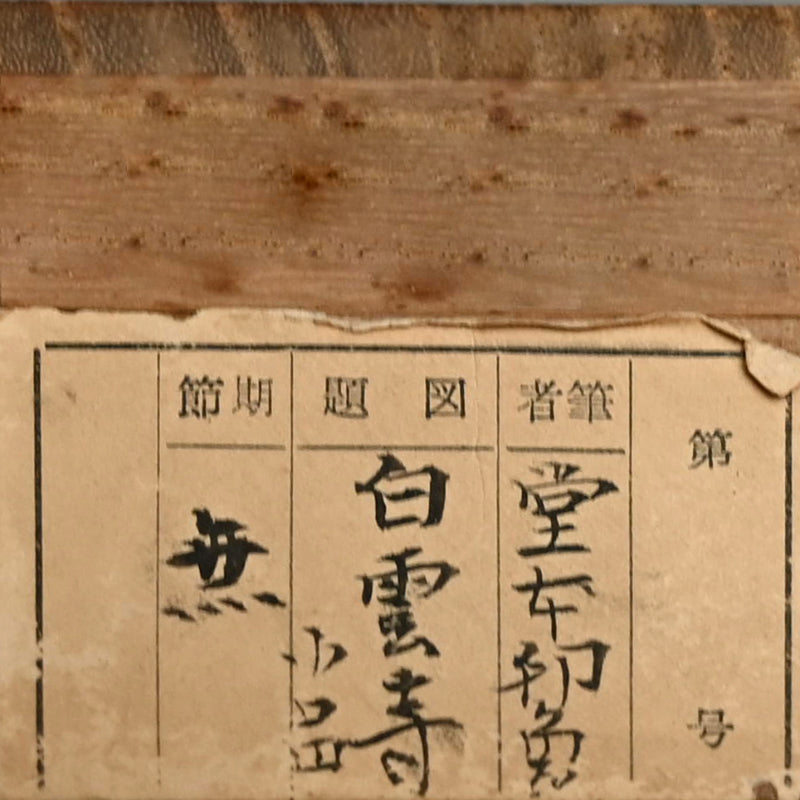
This evocative ink painting presents a quiet temple gate set deep within a mountain landscape by Domoto Insho enclosed in the original signed wooden box dated summer 1923 and titled Hakuun-Ji (White Cloud Temple. Executed with Insho’s characteristically fluid brushwork, the scene suggests a continental architectural setting, conveyed through the steeply pitched tiled roofs and the ornamental roof-ridge finials. The structure bears an inscription on its plaque, while weathered stone steps and twisting shrubs lead the viewer’s eye toward a solitary figure seated at the entrance. Rendered with only a few deft strokes, this robed traveler reinforces the mood of contemplative seclusion that permeates the composition. The surrounding trees, painted in layered washes of ink, frame the temple and soften the angular forms of the architecture. Insho’s handling of foliage—alternating between controlled brush lines and freely scattered ink dots—creates a rhythmic interplay of movement and stillness. The softly toned mountains, recede into the distance and complete the sense of remote solitude. The imagery aligns with Insho’s fondness for Chinese scenery, especially in his earlier decades when he explored traditional ink-painting subjects before turning toward modernist abstraction, and may in fact have been painted on one of his visits to China. This painting exemplifies Insho’s ability to balance expressive brushwork with architectural precision, evoking an atmosphere at once serene, nostalgic, and quietly dramatic. Ink on paper in a fine patterned brocade border extended with rough blue silk and featuring ivory rollers. It is 28.5 x 112 cm (11-1/2 x 44 inches) and is in overall fine condition, with one bend in the center of the image.
Domoto Insho (1891-1975) was born in Kyoto. He studied at the Kyoto Municipal School of Painting under the tutelage of Nishiyama Suisho and graduated in 1921. He contributed regularly to the Nitten and Teiten national exhibitions and won several prizes, including the Imperial Fine Arts Academy prize in 1925. After the end of the Pacific War his reputation spread to an international audience with exhibitions in Italy, France and the USA. In 1961 he was awarded The Order for Cultural Merit. He worked not only in the various manners of Japanese painting, but also oil, industrial art and printmaking. For more on this great artist visit the Kyoto prefectural Domoto Insho Museum. His work is also held by numerous temples in Japan, The Kyoto City Museum of Modern Art, Tokyo National Museum of Modern Art and in the Boston Museum of Fine Art.