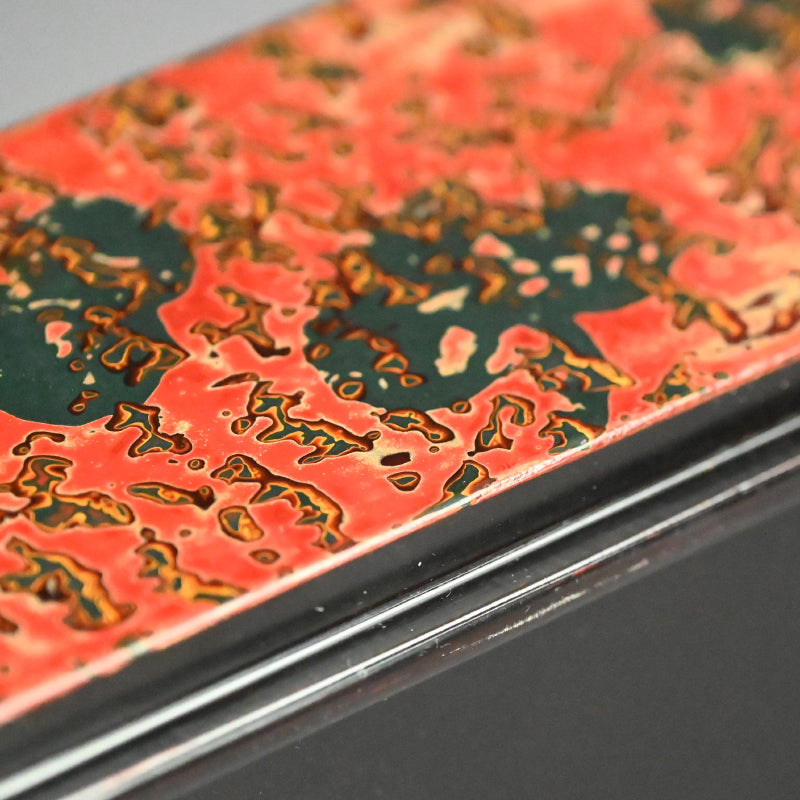
A set of four boxes with marching lid made to stack on top of each other from the Tsugaru Lacquer tradition of Aomori prefecture in Northern Japan dating from the Meiji period. They are 23.5 x 24.5 x 32.5 cm (stacked) which is roughly 9-1/2 x 9-3/4 x 13 inches) and are in overall excellent condition.
Tsugaru lacquer ware, commonly known as Tsugaru-nuri, is a distinctive Japanese lacquer tradition that developed in the northern Tsugaru region of present-day Aomori Prefecture. Tsugaru-nuri emerged under the patronage of the Tsugaru domain in the late 17th to 18th centuries. Unlike courtly or urban lacquer traditions centered in Kyoto or Edo, Tsugaru lacquer evolved as a regional, utilitarian craft, intended for daily use rather than elite ceremonial display. Bowls, trays, writing boxes, and furnishings were produced for local consumption, emphasizing durability and warmth over refinement. What distinguishes Tsugaru lacquer historically is its highly layered construction. Artisans apply numerous coats of lacquer mixed with pigments and materials such as clay powder, charcoal, or eggshell, then incise, polish, and reveal the underlying strata. This process—repeated many times—creates dense, richly textured surfaces that appear almost geological. The technique was well suited to northern Japan’s cold climate, as the thick lacquer layers improved resilience and longevity. Unlike pictorial lacquer traditions, Tsugaru-nuri is fundamentally non-illustrative: beauty arises from process, depth, and accident rather than imagery. During the Meiji period, Tsugaru lacquer adapted to modernization and new markets. Improved transportation allowed wares to circulate beyond Aomori, and the craft gained recognition as a regional specialty. While some standardization occurred, the labor-intensive nature of Tsugaru-nuri ensured that it remained a high-skill practice rather than an industrial product.