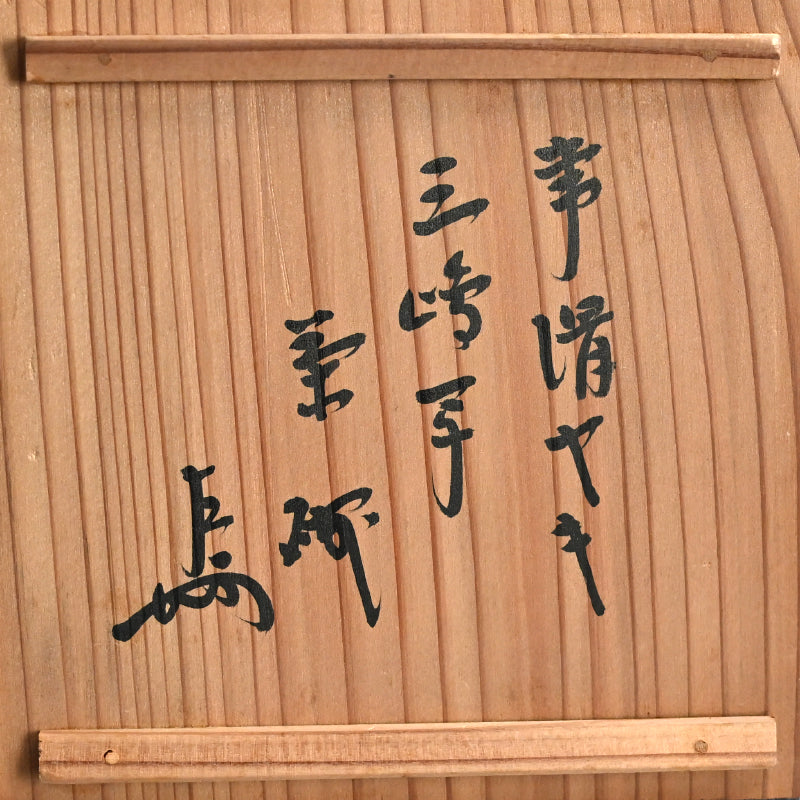
A fine Tokoname pottery bowl with impressions in the Mishima style dating from early to mid 20th century enclosed in a box endorsed by the 13th grandmaster of the Omote Senkei school of tea Sokuchusai titled Tokoname Yaki Mishima Utsushi Chawan. It is perfectly crafted, signed on the base by the maker (Hozan?) suitable to the hands of the Iemoto himself. The bowl is 9.5 cm (just less than 4 inches) diameter, roughly the same height, and is in perfect condition.
Sokuchūsai (1901–1979) was the 13th Iemoto (grand master) of the Omotesenke school of tea, one of the three principal Sen traditions descending from Sen no Rikyū. His personal name was Mujin Sōsa, and he succeeded as head of Omotesenke in 1937 following the death of his father, the 12th grand master Seisai. In the lineage of Omotesenke, Sokuchūsai stands alongside earlier influential masters such as Rokurokusai (11th generation) and Seisai (12th generation) as one of the key figures responsible for carrying the tradition from the late nineteenth century into the modern era. He was succeeded by his son Jimyōsai, the 14th grand master of Omotesenke.
For students of tea culture, Sokuchūsai is one of the most important modern tea masters because he guided Omotesenke through the turbulent years before, during, and after the Second World War. While earlier generations had focused on preserving the family tradition through the Meiji restoration and modernization of Japan, Sokuchūsai established many of the institutions that allowed Omotesenke to flourish in the twentieth century. In 1942 he founded the Senke Dōmonkai, and in 1949 organized Fushin'an as an incorporated foundation, creating a modern administrative structure for the preservation and dissemination of chanoyu.
From an art-historical perspective, Sokuchūsai is frequently encountered by collectors because he regularly inscribed boxes (hakogaki), assigned poetic names (mei) to tea utensils, and expressed preferences (konomi) for particular forms of tea ceramics, lacquerware, bamboo works, and metalwork. A tea bowl bearing a box inscription or kaō by Sokuchūsai generally indicates that the object was appreciated within the Omotesenke tradition and can significantly enhance its provenance and desirability.