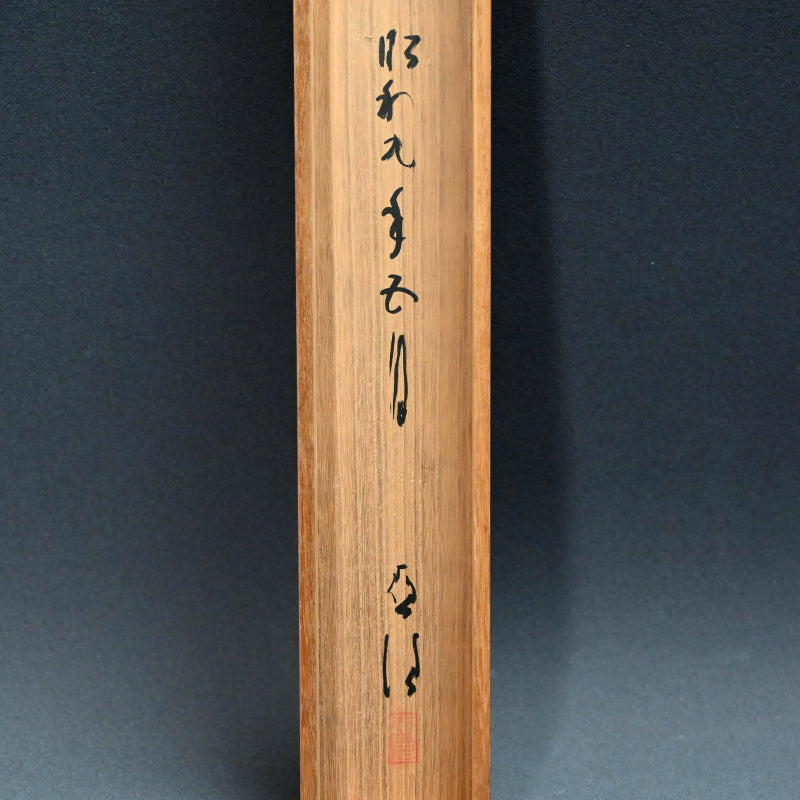
Tadpoles scatter in the water like blossoms in the wind on this playful image by Usuda Aro in the original signed wooden box dated the 7th month of 1934 titled Yamazakura (Mountain Cherry). In the poem the artist compares tadpoles after the end of the rainy season to blossom petals scattered in the water. Ink on paper in a fresh green silk border with large bone rollers, the scroll is 38.5 x 203 cm and is in overall fine condition.
Usuda Aro (1879–1951) was a pioneering haiku poet of the Meiji through Shōwa periods whose independent vision helped reshape modern haiku. Born in Komoro in Nagano Prefecture in 1879, he studied at Komoro Gijuku before graduating from the Wafutsu Law School (now Hōsei University) in 1904. During his student years he received instruction in tanka from Yosano Tekkan and in haiku from Takahama Kyoshi, influences that grounded him in both classical and modern verse. After working as a reporter for the Telegraph News Agency and later as editor-in-chief of the Yokohama Trade Newspaper, he joined the Yamato Shimbun. In 1915 he emerged on the national haiku stage with the founding of the journal Shakunage (Rhododendron), co-established with Ōsuga Otsuji, while also serving as a selector for newspapers such as the Shinano Mainichi. A vocal critic of both Kyoshi’s Hototogisu school and Kawahigashi Hekigotō’s New Trend haiku, Usuda called for a fundamental reform of the haiku world. Looking to the examples of Matsuo Basho and Uejima Onitsura, he asserted that authentic haiku arises from direct engagement with nature, aspiring to create poems that embodied a distinctly Japanese aesthetic rooted in lived experience. Resigning from the Yamato Shimbun in 1916, he devoted himself fully to composition. Though childless, he adopted his six-year-old niece in 1919 after the death of his sister. A rupture with his co-founder Otsuji in 1918 marked a turning point, yet Shakunage remained central to his activity until the Tokyo air raids of March 10, 1945 destroyed its printing house, forcing a temporary suspension. Usuda evacuated with his family to Nishitama, later relocating the printing operations to Nagano City and reviving Shakunage in 1946, though this same year brought the death of his wife. He continued to write and mentor until his death from a cerebral hemorrhage in 1951 at the age of seventy-three. Through Shakunage, he fostered a significant circle of disciples—among them Ōno Rinka, Shinohara Bon, Kuryū Sumio, and Tanaka Yasuke—leaving a lasting imprint on twentieth-century haiku.