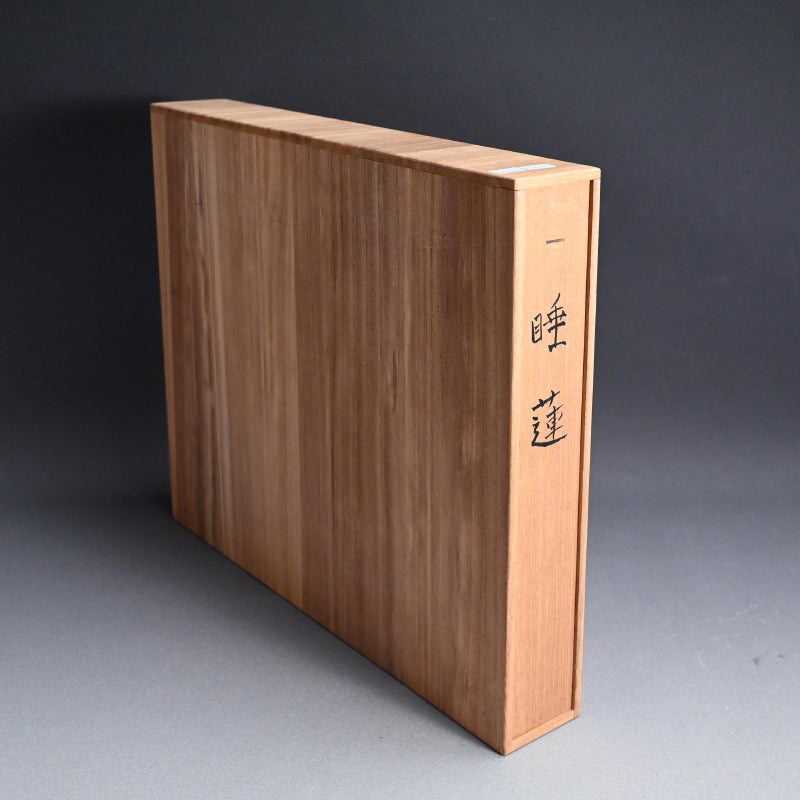
A serene wood carving of a frog on a leaf in a Lilly filled pond by Kawahara Masashi mounted in an artist carved frame enclosed in the original signed wooden box titled Suiren. The natural wood grain forms the ripples of the pond water brushed by a breeze, with light accents of gold throughout as if everything were reflecting the sunlight. The carved wooden panel is mounted in a frame of clear grained wood, the tiny chisel marks creating an orange-peel like texture attesting to the great skill of the artist. It is 46 x 38 x 5 cm (18-1/4 x 15 x 2 inches) and is in excellent condition.
Born in Inami in 1965, Kawahara Masashi began training in wood carving under his father, Kawahara Kazuo, in 1984. His work received early recognition when he was awarded the Grand Prize at the 46th Toyama Prefectural Exhibition in 1991. In 1996, he collaborated with Marc Dillier on a monumental sculpture for the Aubade Hall, and in 1998 he completed a large wall relief for the Hotaruika Museum, further establishing his reputation as a contemporary wood sculptor grounded in traditional craftsmanship.
Inami woodcarving traces its origins to 1390, when Zuisen-ji Temple was founded and later repeatedly rebuilt after fires and calamities. During a major reconstruction in the mid-Edo period, the Kyoto temple carver Maekawa Sanshiro was sent to oversee the decorative carvings, and local craftsmen, including Banshoya Shichizaemon, learned advanced techniques under his guidance. From this exchange, a distinct regional carving tradition emerged.
By the late Edo and Meiji periods, Inami woodcarvers expanded beyond temple and shrine commissions, developing refined carved transoms (ranma) for private homes. The craft continued to flourish into the modern era, leading to the formation of the Inami Woodcarving Cooperative in 1947 and its designation as a nationally recognized Traditional Craft in 1975. Today, Inami carving remains active in both traditional religious architectural projects and contemporary artistic production.