Stunning Edo Black Raku Chawan w/ Gold Repair ー六世 覚々斎 宗佐 "黒楽平茶碗"
Stunning Edo Black Raku Chawan w/ Gold Repair ー六世 覚々斎 宗佐 "黒楽平茶碗"
Item Code: K054
Couldn't load pickup availability
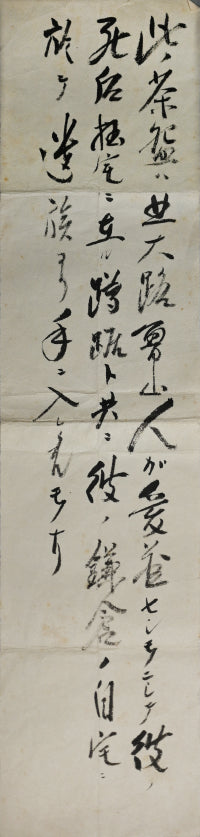
A spectacular Kuro Raku Hira-chawan named Ryusen (Dragon Spring) divided down the middle by a thin bulbous vein of gold enclosed in an ancient kiri-wood box annotated inside by the 6th Iemoto Grand Master of Urasenke Kakukakusai (1678-1730). A note on the side reads Sonyu Black (attributing the bowl further to Raku Sonyu (1664-1716) and the bowl certainly bears the dry black for which he was famed. It is 14.5 cm (just under 6 inches) diameter, 6.5 cm (2-1/2 inches) tall and in excellent condition. A long note inside appears to state the bowl was (received from) an heir of Kitaoji Rosanjin upon visiting his Kamakura residence.
Raku Sonyu was born a son of Kariganeya San'emon and married Myozu, the daughter of Ichuinyu, becoming adopted into the Raku family. He succeeded as the 5th generation in 1691. In 1708 he took the tonsure, assuming the retiring name of Sônyû. His real father, Kariganeya San'emon was the youngest brother of Ogata Sôken, whose sons, Ogata Kôrin and Kenzan, were his cousins. Kôrin and Kenzan formed a unique, highly decorative style of paintings and ceramics called the “Rimpa School” during the Genroku period that reached the height of social and political stability. Nonetheless, Sônyû pursued his creative inspiration more in the simplistic, non-decorative tea bowls of the Raku founder Chôjirô in his effort of establishing his own style. His dry, matt black glaze, commonly known as kase glaze, is a proof of Sônyû's inclination for the style of Chôjirô.
Kakusai lost his father, who was also his teacher, when he was young, and officially took over the Omotesenke school at the age of 18. He was a master who spent 32 years, until his death at the age of 52, searching for a new way of tea ceremony. It is said that Kakusai's tea ceremony, while fully inheriting Rikyu's style, was open-minded and stylish. As the name of the era changed from Genroku to Kyoho and merchant culture matured, it can be said that the way the tea ceremony was conducted needed to change. If we were to describe the style of tea in a word, it might be called "freedom." Kakusai's tea, which valued the spirit of enjoying tea without being bound by form, was criticized at first, but later attracted many disciples. In addition, the social role played by the tea ceremony was beginning to change at the time, and his friendship with Yoshimune, who had become a shogun, may have been a driving force in opening new frontiers for tea. Furthermore, it is said that the friendship with Yoshimune was helpful when Kakujousai and then Joshinsai pioneered new frontiers in tea, and helped spread the word to the townspeople. There are a large number of items that have survived as favorites, and among them, tea bowls, shelves, tea utensils, flower vases, and pots are often noticed. Its characteristics, in a nutshell, are the harmony of wabi and chic. A casual sense of chic shines through in Rikyu's gentle, wabi style. His son Joshinsai, the 7th generation, established a new tea ceremony and is called the founder of Omotesenke Chukyo, and it was Kakusai who laid the foundation for it. In this sense, the opportunity for the later rise of the tea ceremony can be seen in Kakusai's tastes.
Kitaoji Rosanjin (1883-1959) They say adversity is the mother of invention, and Rosanjin can be said to epitomize that expression. Born during the tumultuous first half of the Meiji period in the cultural center of Kyoto, he was adopted at age six by a woodblock carver. He showed an early genius for calligraphy, and began his early manhood as a carver of seals and carver/painter of shop signs after a brief apprenticeship to a pharmacy. He also taught calligraphy and bought and sold antiques during these early years. In 1921 he founded what would become the impetus for his life’s work, his first restaurant, the Bishoku club, and followed in 1925 with a restaurant in Tokyo called the Hoshigaoka. Rosanjin began working in ceramics to replace the collection of dishes that was destroyed in the 1923 Kanto Earthquake. He was largely a self-taught artist with a diverse range, beginning with a kiln on his rented property .in Kamakura, and later paying visits for brief apprenticeships to many of the days top artists. He retired to work exclusively on the arts in 1936. Magazine editor, lacquer artist, metal-working and finally store owner in Tokyo’s Ginza, Rosanjin was everywhere at once. He was displayed at the museum of Modern Art in New York in 1954, a rare honor indeed for living artist. Like his contemporary, Kawai Kanjiro, Rosanjin was offered the title of Living National Treasure in 1955 for his work in Oribe pottery, but refused the offer.
Share