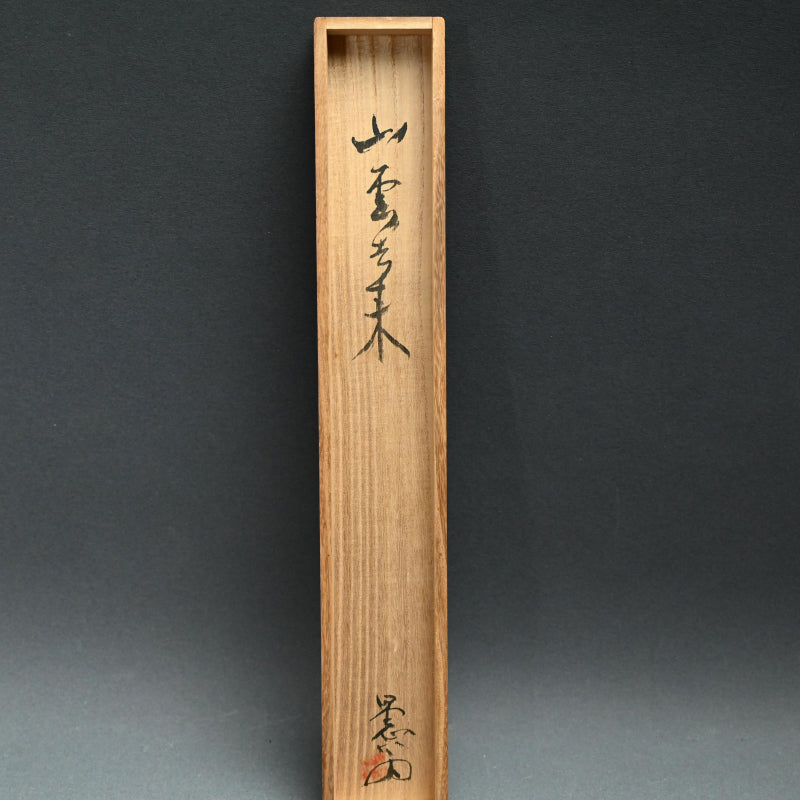
This expressive ink mountainscape is the work of Fujii Tatsukichi (1881–1964)—a pioneering figure often hailed as the father of the Japanese Arts and Crafts Movement and a central architect of Japan’s modern concept of kōgei and design as an integrated art form. Active across an astonishing range of media—including lacquer, pottery, stencil-dyeing (katazome), woodblock printing, sculpture, interior design, and even architecture—Fujii sought throughout his career to dissolve boundaries between fine art and craft. The painting’s rugged verticals and softly dissolving washes recall both the Chinese Song-Yuan ink tradition and the modernist abstraction that Fujii helped usher into Japanese decorative arts. Dynamic yet spare, the mountainscape reflects a mind equally attuned to nature, craft, and the distilled poetry of form. In this sense, the scroll stands as a compelling expression of Fujii Tatsukichi’s lifelong effort to expand what Japanese art could be. Ink painting was not Fujii’s primary medium, yet works such as this reveal how deeply he internalized the visual language of literati aesthetics. Using a restrained palette and a vocabulary of dry, broken brushstrokes, he constructs a craggy peak rising sharply through drifting veils of mist. The forms are evoked rather than described—built from suggestive texture, tonal modulation, and deliberate emptiness. This approach mirrors Fujii’s design philosophy: the belief that beauty lies in the expressive power of materials and the direct, unforced movement of the hand. It comes enclosed in the original signed wooden box enclosed in a red lacquered outer wooden box. Ink on paper in a silk border with ceramic rollers. It is 40.5 x 152 cm (16 x 60 inches).
As mentioned, Fujii Tatsukichi (1881-1964) could be considered the father of the Arts and Crafts Movement and the modern concept of design as an art form in Japan, and most certainly an artist not to be defined by one medium. He was born in Hekinan city, Aichi prefecture near Nagoya. He was, along with Kishida Ryusei, Saito Yori and Takamura Kotaro, a founding member of Hyuzan-kai in 1912, the first organization in Japan dedicated to Expressionism in all forms through all mediums. He was one of the most important reformers of the traditional arts in Japan and a pioneer of the modern craft world. His creativity touched nearly every area: embroidery, dyeing, weaving, lacquer, pottery, papermaking, metalwork, woodwork, Painting, calligraphy, woodblock carving and printing. In the 1920s he wrote articles on home crafts for Fujin no Tomo, one of the most widely read women’s magazines of the day. He also held the first professorship of design at the Imperial Art School (mod. Musashino Art University), and his influence was enormous. The museum of contemporary art in Tatsukichi’s birth place, Hekinan, is named after him. In 1932 he established a studio in Obara, where he headed the movement to reinvent the Japanese craft paper industry. That studio (Mufuan) has been moved and is now used as a tea house by Seto City. A major retrospective on his life work travelled japan in 1996 spearheaded by the Tokyo National Museum, “Fuji Tatsukichi, Pioneer of Modern Crafts”.