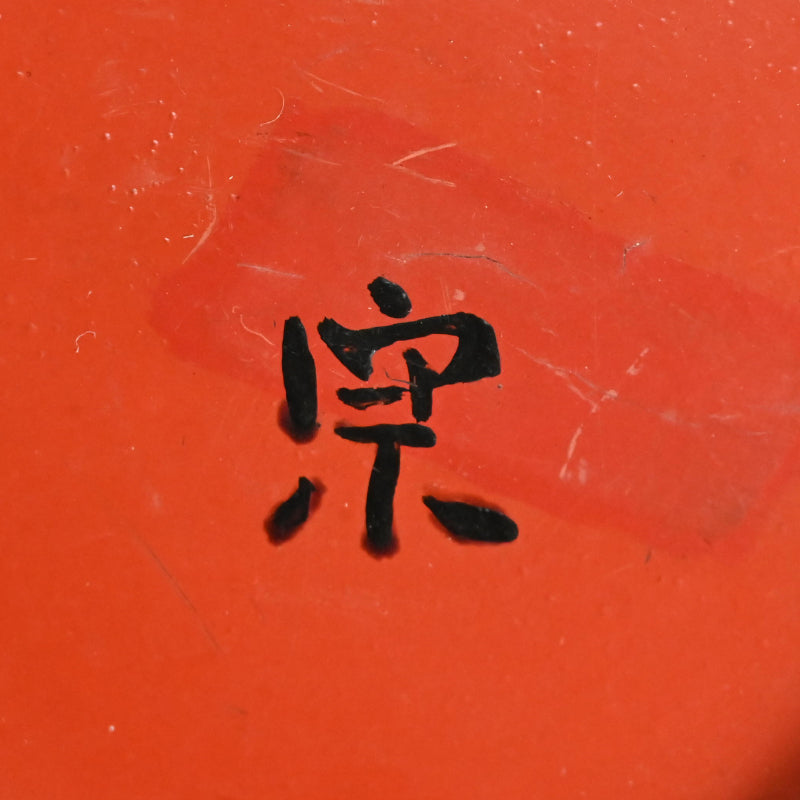
An exquisite set of 5 17th-18th century lacquered bowls with flaring rims, beautifully turned with unusually refined thin bodies covered in black and red lacquer, and bearing two marks on the base, a circled character for up (heaven) and what appears to be Mune, a common character in a male name. They are magnificently worn, with black lacquer showing through where the red has been worn away from use. Theya re roughly 13.5 cm (5-1/4 inches) diameter, 5 cm (2 inches) tall. Well taken care of, still, there are chips to the thin edges and feet, and one repair to the rim about 2.5 cm (1 inch) long on one of the bowls.
Negoro lacquerware is one of Japan’s most distinctive lacquer traditions, celebrated not for pristine polish but for the slow revelation of time itself—a red surface gradually wearing away to expose black beneath. Negoro lacquerware takes its name from Negoro-ji, a powerful Shingon Buddhist temple complex in present-day Wakayama Prefecture. From the late Heian through the Muromachi period, Negoro-ji functioned as a vast religious and economic center, complete with workshops producing ritual implements, furnishings, and everyday utensils for monastic life. Negoro pieces were utilitarian by design: bowls, trays, sutra stands, writing boxes, and ritual vessels meant for constant handling. Their durability—thick wooden cores coated first in black lacquer, then overlaid with vermilion red—was paramount. The hallmark of Negoro-nuri lies in its inevitable transformation. As objects were used, the red lacquer thinned at edges and contact points, allowing the black underlayer to emerge naturally. Over years—and sometimes centuries—each object acquired a unique topography of abrasion; rims darkened by lips and hands, corners softened by movement and surfaces mottled like weathered architecture. This was not planned ornamentation, but the result of lived time. This quality later resonated deeply with tea practitioners, who recognized in Negoro lacquer a material expression of wabi—quiet imperfection, humility, and endurance. In 1585, Toyotomi Hideyoshi attacked Negoro-ji, destroying much of the temple complex and dispersing its monks. Production at the site effectively ceased. Yet paradoxically, this catastrophe ensured Negoro lacquer’s survival: objects entered circulation among warriors, merchants, and tea masters, where their aesthetic value was newly appreciated. Therefore, by the late Momoyama and early Edo periods, old Negoro pieces were already prized as antiques. During the Edo period, Negoro lacquer became firmly embedded in chanoyu (tea ceremony) culture. Tea masters valued it alongside Bizen ware, Shigaraki jars, and weathered bamboo utensils—objects that bore the marks of time rather than resisting it.