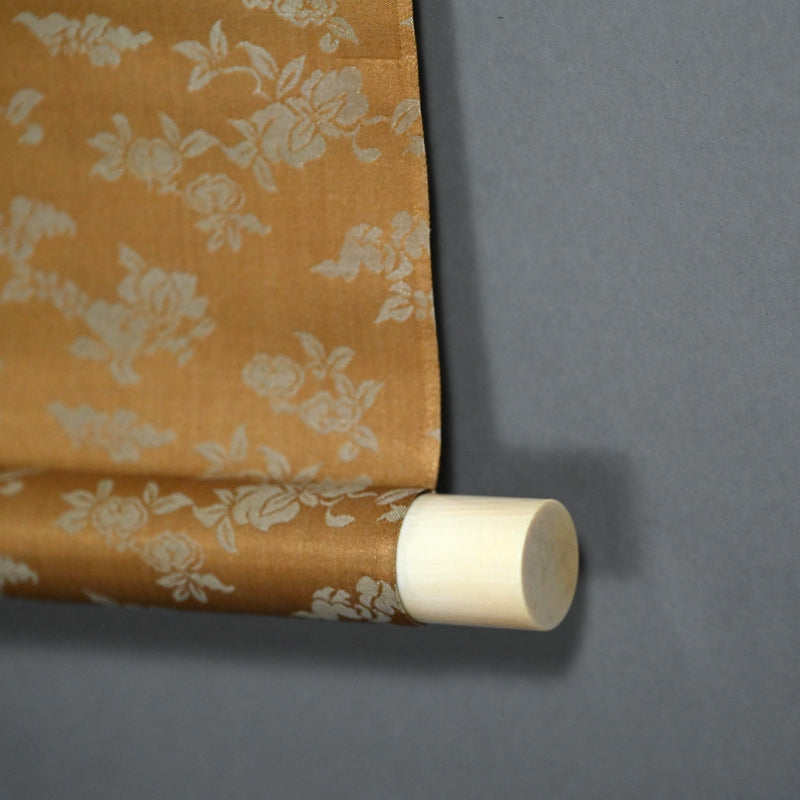
Bold black lines form the structure filled with Mi-fu Dots form a tree sheltered village along the water’s edge, in the distance deftly brushed dry strokes in soft shades of gray form monolithic crags towering over the placid scene, a poem scratched like sunrise along the vertical columns. A compelling in landscape by Fukuda Kodojin punctuated curiously with a stamp in red at the base of the steps from the waters leading to the village as if the artist himself were enjoying the solitude of fishing. Wisps of mist flow from the village into the distant valleys. On the highest branch, two irregular strokes delineate a crow patiently watching over the scene. Ink on paper in a patterned satin border with ivory rollers (the ivory will be changed for export). It is 47 x 202 cm (18-1/2 x 79-1/2 inches) and in fine condition.
Fukuda Kodojin (1865-1944) an eccentric self taught artist, his status as a poet, calligrapher and literati artist has reached legendary status. Born at a time of great change (4 years before the final fall of the Edo Government), he lived through the westernization of Meiji, Taisho Democracy, the rise of Imperialism and final defeat of the Showa eras. He was self taught, part of a small group of artists existing outside conventional circles in pre-war Japan. He moved to a village outside of Kyoto in 1901, where he supported himself and his family by privately tutoring those who wished to learn Chinese-style poetry. Kodojin was simply a scholar. His poetry, painting, and calligraphy all stem from a life-long cultivation of the mind. He was known to have taken the time just before his death to destroy the large portion of his own remaining work, leaving only that which must have met some personal criteria. For more on his life see the book Old Taoist, or Unexplored Avenues of Japanese Painting. Twenty five paintings by the artist formed a private exhibition (from Gitter-Yelen) at the New Orleans Museum of Art in 2000, and he is part of the Hakutakuan collection among many others.