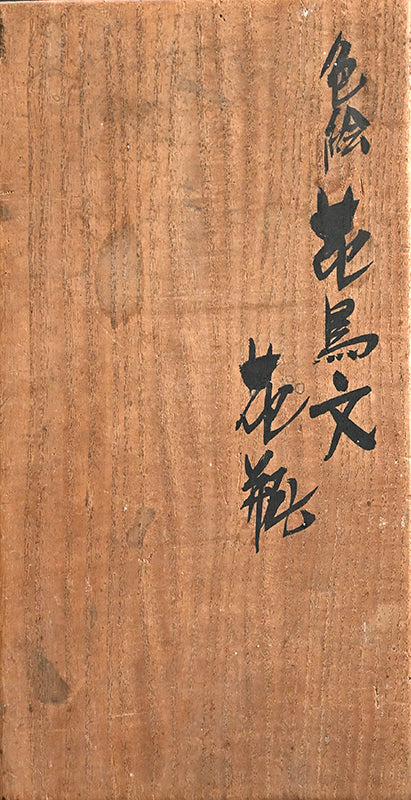
Phoenix soar over late summer and autumnal floral explosions on this pair of baluster form vases by Kiyomizu Rokubei III dating from the mid to later 19th century (Late Edo to Meiji period) enclosed in a custom made wooden box titled Iro-e Kachomon Kabin and annotated by the 7th generation head of the family. They are 16 x 16-1/2 x 31 cm (roughly 6-1/2 inches diameter, 12-1/2 inches tall) and in excellent condition.
Kiyomizu Rokubei III (Koto Kuritaro, 1820-1883) was born in Kyoto second son of Rokubei II. He took over the family kiln even younger than his own father at the age of 18 in 1838. This was the beginning of the Bakumatsu era, the fall of the Edo Shogunate, and Kyoto would play center stage in this tumultuous era. Vagabonds, Rebels, Reformers and Loyalists made mayhem in the streets and battles raged across the city while foreign powers leveraged unfair treaties against the reluctant Shogun. Many advanced techniques were imported to Japan through Rangaku (Dutch studies) at the open port of Nagasaki and then from a growing number of locations after the arrival of Commodore Perry in 1853. In 1868 the Edo government fell, and the capital was moved to Tokyo. It is said Rokubei III then changed the family surname from Koto to Shimizu (an alternate reading of Kiyomizu), taking advantage of the character in the seal which the family used, as well as adopting wholesale the name of the district in which they were based. Rokubei III was aware of the advantages of modernism, while maintaining the traditions of the former generations. He went to Yokohama with Miyagawa (Makuzu) Kozan in 1868. However, unlike Kozan, who would move his entire operation to Yokohama, Rokubei made the decision to remain in Kyoto, and although he did create works in the modern style and to suit Western taste, (he was one of the artists commissioned to create pottery for the 1879 visit of former US president Ulysses S. Grant) he maintained a fairly conservative oeuvre oriented toward the Japanese aesthetic. He excelled in porcelain wares, and was much lauded in his lifetime being awarded at a multitude of domestic exhibitions as well as internationally in Paris, Sydney and Amsterdam. Like his forebearers, he was very much a part of the Kyoto scene at the time, and many works created by Rokubei III were decorated by top painters of the era. Important works by poet/artist/nun Otagaki Rengetsu were created in the studio of Rokubei III. Work by Rokubei III is held in the collections of the Metropolitan Museum of art New York, the Kyoto Hakubutsukan Museum and Ashmolean among others.