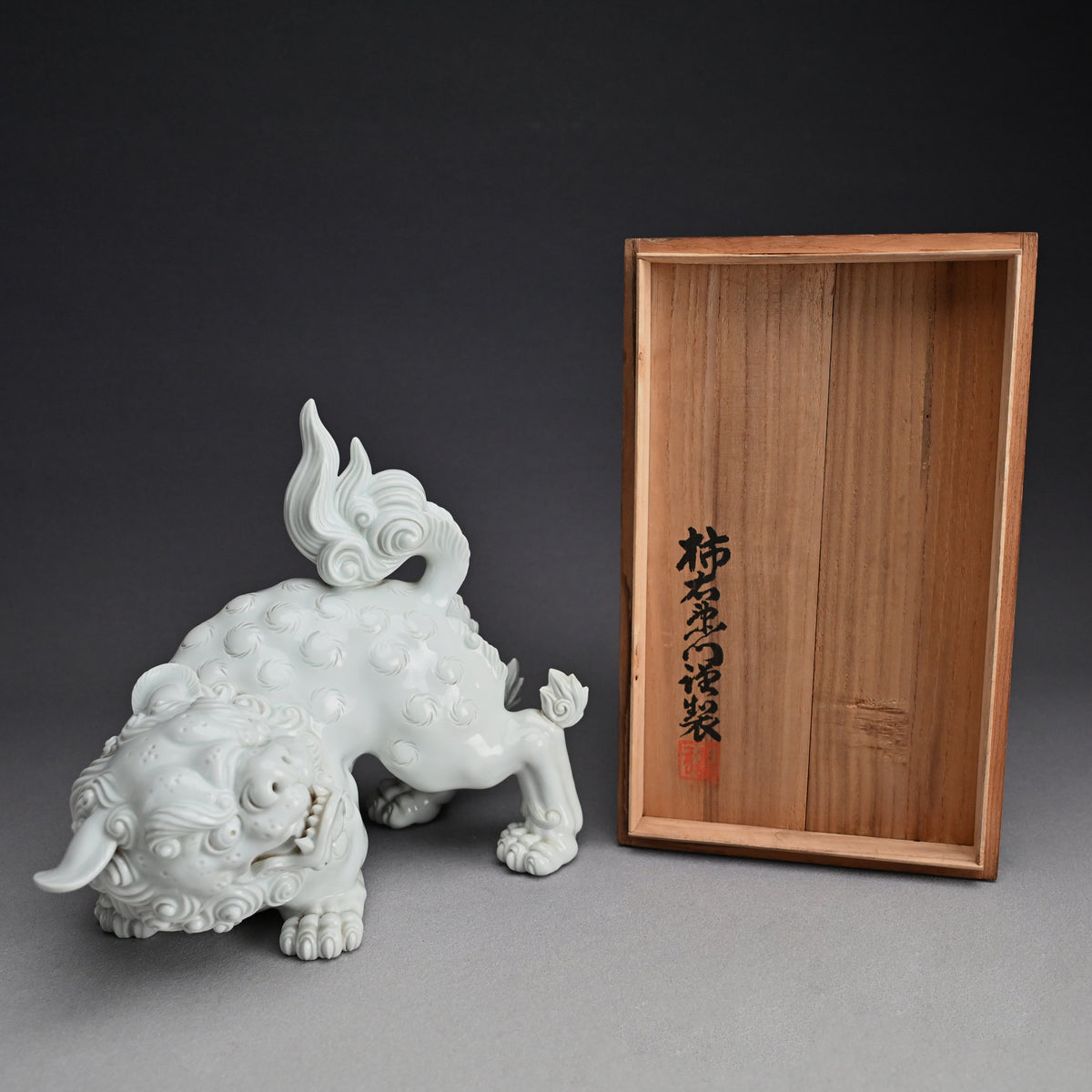
A fierce roaring Shishi lion in sheer white porcelain by Sakaida Kakiemon XII enclosed in the original signed wooden box. The mythical creature is signed in underglaze blue beneath. It is 17.5 x 28 x 24.5 cm (7 x 11 x 10 inches) and is in perfect condition but for the flame like tuft on the back left leg which appears to have been re-attached at its base (see close-up photos).
A Shishi is the Japanese interpretation of the mythical lion of Buddhist Asia. Although it is often called a “lion-dog” in English, that term is somewhat misleading: the shishi is fundamentally a lion, albeit one transformed over centuries into a fantastic creature bearing little resemblance to an actual African or Asian lion. The imagery ultimately derives from India, where the lion was an ancient emblem of royalty and spiritual power. As Buddhism traveled through Central Asia into China, artists who had never seen living lions increasingly transformed them into fantastic beasts. The Chinese shishi acquired enormous eyes, curling manes, powerful bodies, and almost dragon-like features. This stylized lion reached Japan together with Buddhism and continental court culture, particularly during the Asuka and Nara periods. In Japan it became known as Shishi, literally “lion.” The related term Karajishi, literally “Chinese/Tang lion” emphasizes its continental origin.
The essential character of the Shishi is protective. Its ferocious appearance was believed to drive away evil influences and guard sacred spaces. Consequently, Shishi appear not only as monumental guardians but throughout Japanese decorative art: in Buddhist sculpture, architectural carving, screens and paintings, lacquer, ceramics, metalwork, textiles, netsuke, sword fittings, and tea utensils. Yet the Japanese Shishi is rarely simply frightening. Artists often endowed it with an extraordinary combination of ferocity and playfulness. It may bare its teeth and possess tremendous claws, while simultaneously twisting, bounding or playing almost like a cat. That tension between terrifying supernatural power and exuberant vitality is central to its appeal.
Sakaida Kakiemon (1878-1963) was born the first son of the 11th generation head of the Sakaida family, and learned from his father, succeeding the family name in 1917. Rediscovering the Nigoshide technique was his life’s research, and together with his son grasped the essentials in 1947, presenting the first piece for public viewing in 1953. The Nigoshide technique was subsequently named an important cultural property, and the Kakiemon family designated the carriers of the tradition. Held in the collection of The Tokyo National Museum of Modern Art and Seattle Art Museum among others.