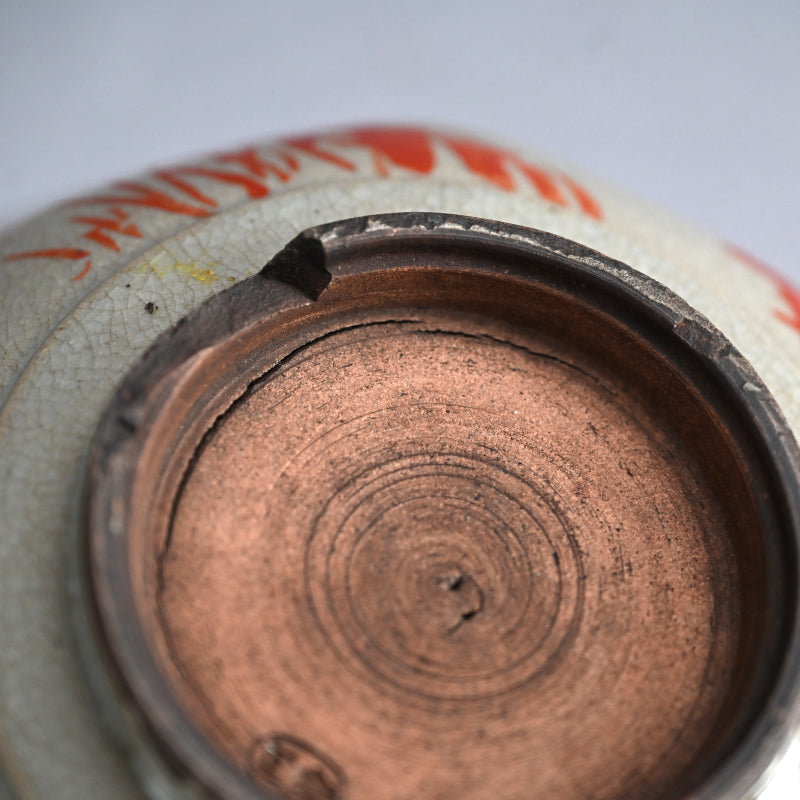
A small sweets dish from the Akogi kilns decorated with iris growing among stones outside, but showing a distinct western influence on the interior design. It is stamped inside the footing Akogi, and dates from the Meiji to Taisho periods. It is 17 cm (7 inches9 diameter and in excellent condition, enclosed in an old wooden box.
Akogi-yaki is pottery produced in Tsu City, Mie Prefecture, named after the Akogiura region. It draws its lineage from Banko-yaki and has a history of over 200 years. The founder of Akogi-yaki is believed to be Numabe Zuiga, a disciple of Numabe Rozan, the originator of Banko-yaki. Zuiga was invited by the Todo domain to establish a kiln in the village of Ando, where he began producing Banko-yaki. Initially called Ando-yaki, the kiln later relocated to a site near the castle at Babayashiki. Around this time, it was renamed Akogi-yaki, after the nearby Akogiura. The kiln became a valued supplier to the domain, primarily producing everyday utensils. After an interruption in production, Kurata Kyuhachi, a wealthy merchant, revived Akogi-yaki under the domain’s orders. However, Kurata treated it more as a hobby. Following the Meiji Restoration, government support ceased entirely. Wealthy merchants collaboratively sustained Akogi-yaki, but conflicts arose, leading to the abandonment of older kilns (Sendo Akogi) due to a lack of skilled workers, and newer kilns (Dote Akogi) failed due to poor management.
Despite many efforts to preserve it, Akogi-yaki faced repeated closures. In 1901 (Meiji 34), the Akogi-yaki Ceramic Company was established but soon shuttered due to the economic downturn caused by the Russo-Japanese War. Attempts by entrepreneurs and craftsmen to revive the pottery continued, but small-scale production struggled to compete with mechanization. In the Showa era, Tsu City Mayor Horikawa Biya invited Banko-yaki craftsman Fukumori Enji to help revive Akogi-yaki. Initially, operations were difficult, but postwar efforts shifted focus from everyday utensils to high-value tea wares, leading to its eventual revival. Akogi-yaki is designated as a traditional craft by Mie Prefecture.