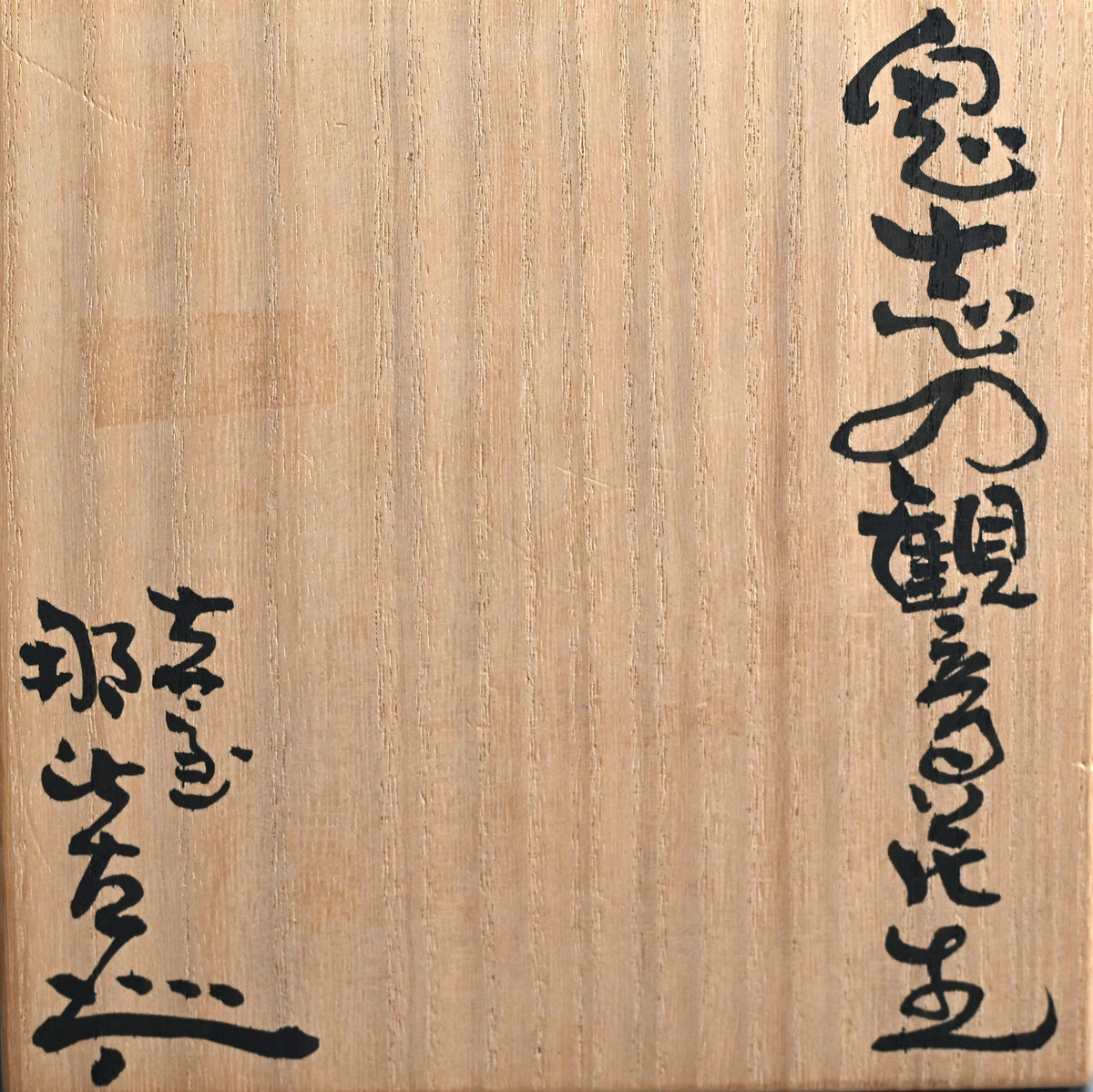
A powerful flower vessel by Tsukigata Nahiko enclosed in the original signed wooden box titled Oni-Shino Kannon Hanaire. The tall, roughly cylindrical form swells through the shoulders before drawing inward and opening again at the mouth, its irregular profile emphasizing the vigorous hand of the artist. Thick Shino glaze runs freely over the deeply worked surface in layers of milky white, amber, iron brown and smoky grey, pooling into glassy passages and breaking over ridges of exposed clay. Particularly striking are the dark iron-rich rivulets descending through the lighter glaze, giving the surface an almost molten quality. The underside, largely hidden in use, provides a dramatic counterpoint of exposed reddish clay, white glaze and dark vitrified deposits. Tsukigata developed his distinctive Oni-Shino (“Demon Shino”) from the traditions of Momoyama Shino, pushing its heavy feldspathic glaze and forceful firing effects toward a highly individual and expressive form. It is 15 cm (5-7/8 inches) diameter, 25.5 cm (10 inches) tall and in excellent condition.
Tsukigata Nahiko (1923-2006) was not only an accomplished ceramic artist, but also a painter, calligrapher, sculptor and musician. Born in Niigata prefecture, he was at Waseda University in 1941 when he was summarily drafted into the Army. After the war he attended the Arts course of Nippon Daigaku University and was struck by the works of Living National Treasure Arakawa Toyozo, to whom he apprenticed in the arts of Shino and took his mentors work to a new level. Like all art, his was alive and always evolving. Starting with the replication and research of Momoyama techniques to the culmination of his efforts in Oni-shino, Nahiko has taken Shino beyond all others. It was not an easy road, for the first 15 years he worked for a ballet school, spent time as a recluse priest at Myoanji temple, and wandered the country playing the shakuhachi. It was a time of great change in Japan, starvation was rampant immediately after the war and supporting oneself through the little-known art of Shino-yaki was difficult. However, he persevered, along with Toyozo, Kato Juuemon, Kato Kohei and others, to bring Shino to the forefront of ceramic arts. Heavily prized domestically and abroad in his lifetime, his low output and unique quality make his work a must have for collectors.