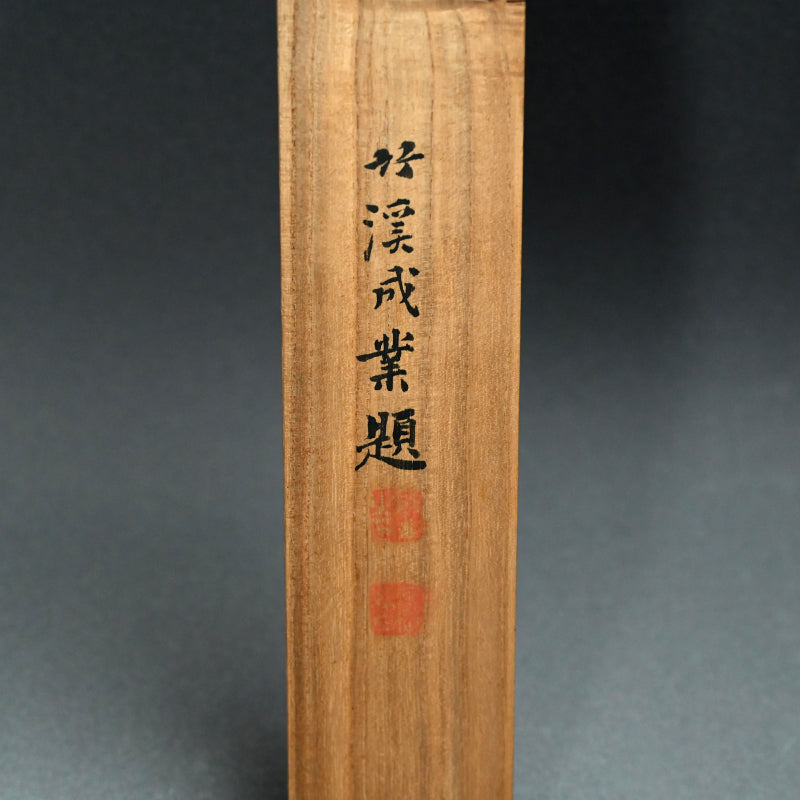
This vertical landscape by Nakabayashi Chikuto unfolds in layered bands of softly modulated ink, revealing a secluded mountain settlement enveloped in drifting mist. Chikuto’s distinctive brushwork—built from finely striated texture strokes and rounded, rhythmic touches—creates a sense of sculpted stone surfaces and dense, breathing forests. Villages and scattered pavilions nestle into the slopes, their simple geometric outlines contrasting with the richly worked foliage of pines and bamboo. In the foreground, a scholar sits quietly within an open veranda, the embodiment of literati ideals of retreat, study, and attunement to nature. Executed with the clarity and restraint characteristic of Chikuto’s mature style, the painting demonstrates his mastery of the Nanga vocabulary—absorbed from early mentors such as Kamiya Tenyu and Yamada Kyujo, refined through his close friendship with Yamamoto Baitsu, and shaped by his deep engagement with Chinese painting theory. The scene’s expansive stillness, its mist-wrapped mountains, and the delicate balance between inhabited and uninhabited space reflect the intellectual calm and poetic sensibility for which Chikutō is acclaimed as one of the foremost theorists and practitioners of the Japanese literati tradition. Ink on paper in a silk border featuring dragon dials and large rosewood rollers. The scroll is 63.5 x 193 cm (25 x 76 inches) and is in fine condition. There is some rubbing to the silk along the top roller bar, evidencing age and use. Otherwise it is in excellent condition. It comes in a period wooden box annotated by his son.
Nakabayashi Chikuto (Chikudo, 1776-1853) was born in Owari, modern day Nagoya, the son of a doctor Nakabayashi Gento. He learned initially under the tutelage of the art collector Kamiya Tenyu and the Nanga artist Yamada Kyujo. He lived variously in his home of Nagoya, Osaka and Kyoto where he was a compatriot of Yamamoto Baitsu, under whom his son, Nakabayashi Chikkei, would study. From the age of 20 he lived in a Buddhist temple, and moved to Kyoto in 1803 to study with Yamamoto Baitsu and Rai Sanyo. He collaborated with Uragami Shunkin and Yamada Kyujo among others in literati circles. Known not only for his excellent painting, he was widely published and the master of many treatises on subjects of the Nanga School and considered the true Nanga school painting theorist of his day.