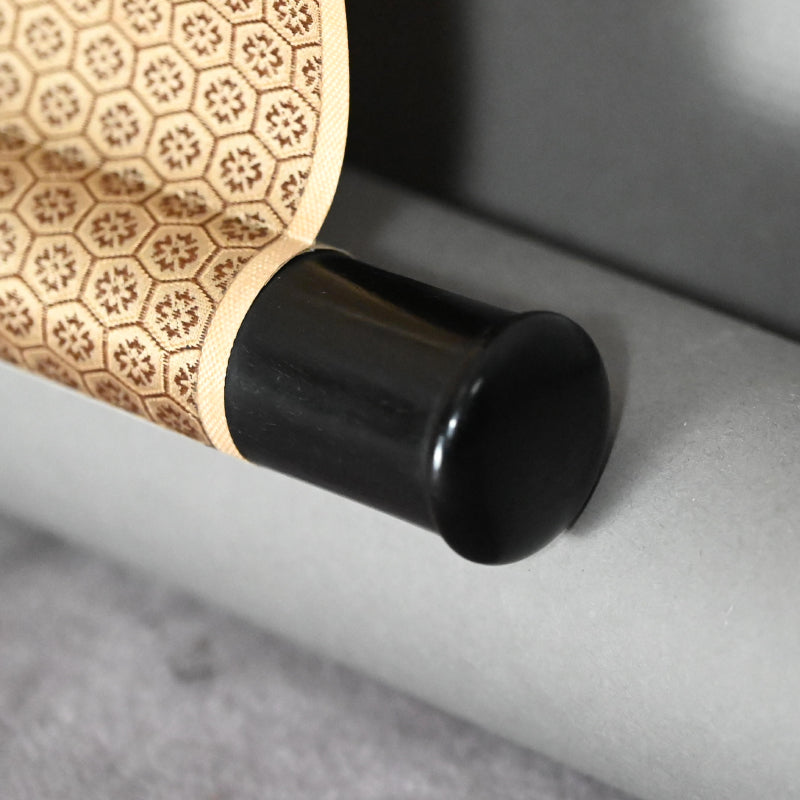
A stunning set of scrolls depicting lotus by Watanabe Shoka beautifully performed with pale ink on satin, an unusual and highly prized material. The image of the flower in blossom is wet, the ink allowed to seep into the soft material creating a lush feeling, while the seasonally later image of the seed pod is brushed in a dryer manner, as if the artist himself were the season, his brush the progression of time. The two scenes are mounted in fine patterned silk with white piping and large turned dark wood rollers, enclosed in a custom-made period wood box. They are 36.5 x 202 cm (14-1/2 x 79-1/2 inches) each and in overall excellent condition.
Watanabe Shoka (1835–1887) was born at the Tahara Domain residence in Kojimachi, Edo, as the second son of the painter and intellectual Watanabe Kazan. Following Kazan’s confinement to Tahara after the Bansha no Goku incident, the family relocated there; Kazan’s suicide when Shōka was seven profoundly shaped his early life. After studying at the domain school Seishōkan, Shōka went to Edo in 1847 and trained under Tsubaki Chinzan at the Takukadō studio, where rigorous critique tempered his development and impressed upon him the burden of inheriting his father’s artistic legacy. In 1851 he served as a painting companion to the Tahara domain heir Miyake Yasunori, and after Chinzan’s death in 1854 he established himself independently as a painter. Upon the sudden death of his elder brother in 1856, Shoka succeeded to the family headship, later marrying Chinzan’s adopted daughter Suma, and in 1864 was appointed karō (chief retainer) of the Tahara Domain. Highly regarded due to his father’s legacy, he assumed major responsibilities during the Boshin War and continued as a senior administrator into the early Meiji period. After the abolition of the domains, Shōka settled in Toyohashi in 1874 and committed himself fully to painting. His so-called “Hyakkaen period,” named after his residence near Yoshida Shrine, marked his emergence as a professional artist. He exhibited works at the Vienna World Exposition (1873) and received the Floral Crest Prize at the First National Industrial Exhibition (1877), followed by further recognition after relocating to Tokyo in 1882, where he won a bronze prize at the First National Painting Exhibition. He later co-founded the Tōyō Kaigakai and contributed to the decoration of the Meiji Palace, though illness limited his participation. Watanabe Shōka died of typhoid fever in 1887 at the age of fifty-three, leaving a legacy as a refined bird-and-flower painter who bridged the cultural worlds of late Edo and early Meiji Japan.