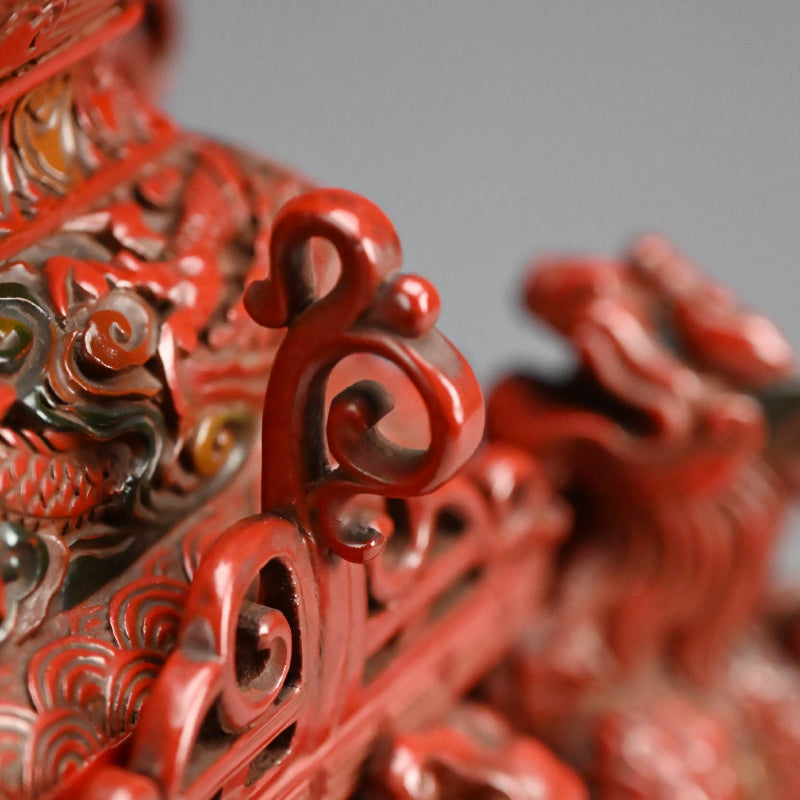
This elaborately carved incense burner (kōro) rises in a tiered architectural form, its structure unfolding upward from a fantastical base of rearing mythical beasts into a baluster body densely populated with narrative relief. The surface is saturated in a deep cinnabar-red lacquer, its lustrous sheen softened by areas of darker tonality that gather within the recesses, heightening the sense of depth and movement. The narrative carving reflects the Meiji-period fascination with pictorial storytelling translated into three-dimensional form. The shoulders are guarded by projecting phoenix-like creatures, their wings arcing outward in bold, symmetrical flourishes, while below, the vessel rests upon a dynamic openwork stand formed by sinuous dragons. These creatures coil and interlock, their bodies attenuated into scrolling limbs that serve both structural and decorative roles—an interplay of strength and ornament characteristic of export-era virtuosity. Crowning the lid, a shishi (lion-dog) surmounts the composition, clutching a brocaded ball beneath its paw, above which rises a flame-like finial of swirling clouds. The carving here becomes almost calligraphic, the lacquered lines flowing upward in continuous, rhythmic motion. The piece exemplifies the Sanuki relief carving tradition developed in Takamatsu, where wood is first deeply carved and then coated with multiple layers of colored lacquer, producing a richly modeled surface with pronounced three-dimensionality.
This incense burner embodies the Meiji period’s synthesis of tradition and display. Rooted in Edo-period craft lineages fostered under the patronage of the Takamatsu domain. it simultaneously reflects the heightened technical bravura and visual density favored in works destined for both elite domestic use and international exhibition. The object oscillates between vessel and sculpture. While nominally functional, its elaborate openwork, animated figures, and theatrical composition suggest a piece intended as much for contemplation as for use. In this way, it stands as a consummate expression of Sanuki carving and lacquering at its most ambitious—where material, technique, and imagination converge into a single, resplendent form. It is 24 x 21 x 56.5 cm (9-1/2 x 8-1/2 x 22-1/2 inches) and is in excellent condition;