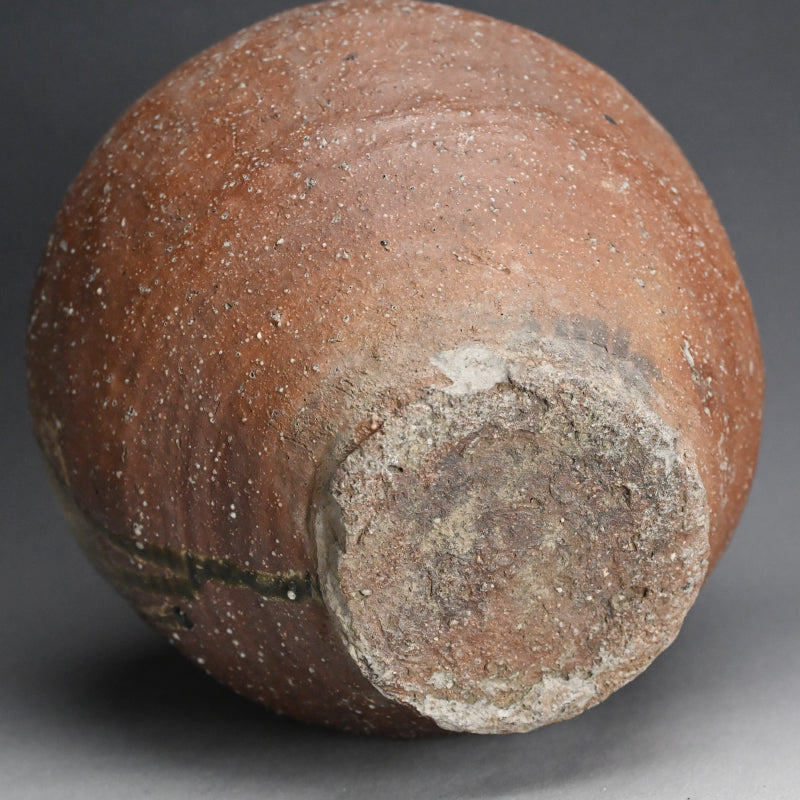
A large Shigaraki Tsubo with a beautiful blast of natural ash glaze over the feldspar studded sunburnt clay dating from the 15th to 16th centuries. Although the neck has been broken away, the body of the tsubo is in excellent condition, with no cracks or repairs. Perfect for flower arranging (and possibly the inspiration for the likes of Tsujimura Shiro and other modern potters of this tradition) it is 38 cm (15 inches) diameter, 44 cm (17-1/2 inches) tall and in excellent condition.
Due to size the cost of shipping will be accrued separately.
Shigaraki is counted among Japan’s celebrated Six Ancient Kilns (Rokkoyō) and developed as an important center of high-fired stoneware during the medieval period. The tradition recognized as Shigaraki today appears to have become established during the Kamakura period, probably in the thirteenth century and under considerable technological influence from Tokoname. By the fourteenth century, however, Shigaraki had developed a character unmistakably its own, producing principally large jars, storage vessels, mortars and other robust utensils required by an increasingly prosperous agricultural society. These vessels were made from the distinctive local clay, relatively low in iron and rich in coarse particles of feldspar and quartz, and were fired without an applied glaze at high temperatures in wood-burning anagama kilns. The resulting surfaces became one of Shigaraki’s defining characteristics: warm tones ranging from buff and golden orange to reddish brown, scattered white feldspar stones that softened or burst through the surface during firing, areas blackened by intense flame, and accidental deposits of wood ash that melted into translucent green or olive natural glaze. The potter could control the fundamental form and the placement of vessels within the kiln, but fire, ash, atmosphere and the mineral composition of the clay completed the work, producing the highly individual surface “landscapes” for which old Shigaraki would later be admired. During the Muromachi period, Shigaraki production remained fundamentally utilitarian. It was precisely this lack of self-conscious artistic refinement that eventually transformed Shigaraki’s place within Japanese culture. During the fifteenth and sixteenth centuries, a new aesthetic gradually emerged around wabicha, in which cultivated tea practitioners began to recognize beauty in humble, irregular and ostensibly ordinary Japanese objects. Shigaraki, together with Bizen, was among the earliest native stonewares to undergo this extraordinary change in status. Within wabicha, the irregular Shigaraki surface—with its scars, stones, accidental ash, fire marks, distortions and asymmetries—offered an alternative to the technical perfection and sophisticated decoration of imported ceramics. Its beauty seemed to arise naturally rather than from conspicuous artistic effort. The warm, relatively pale Shigaraki body was particularly distinctive among Japan’s medieval unglazed stonewares; its low iron content produced a gentler, brighter fired surface than the darker bodies characteristic of some other kiln centers, while its feldspar inclusions created a granular, almost geological vitality. By the Momoyama period (1573–1603), potters were increasingly making Shigaraki specifically for tea. Under the aesthetic influence of Sen no Rikyū and his contemporaries, irregular form, kiln scars, ash, scorching and exposed stones became qualities to be consciously appreciated. Shigaraki thus came to embody a central ideal of wabi: beauty arising not from perfection, but from the subtle balance between human intention and the unpredictable forces of nature.