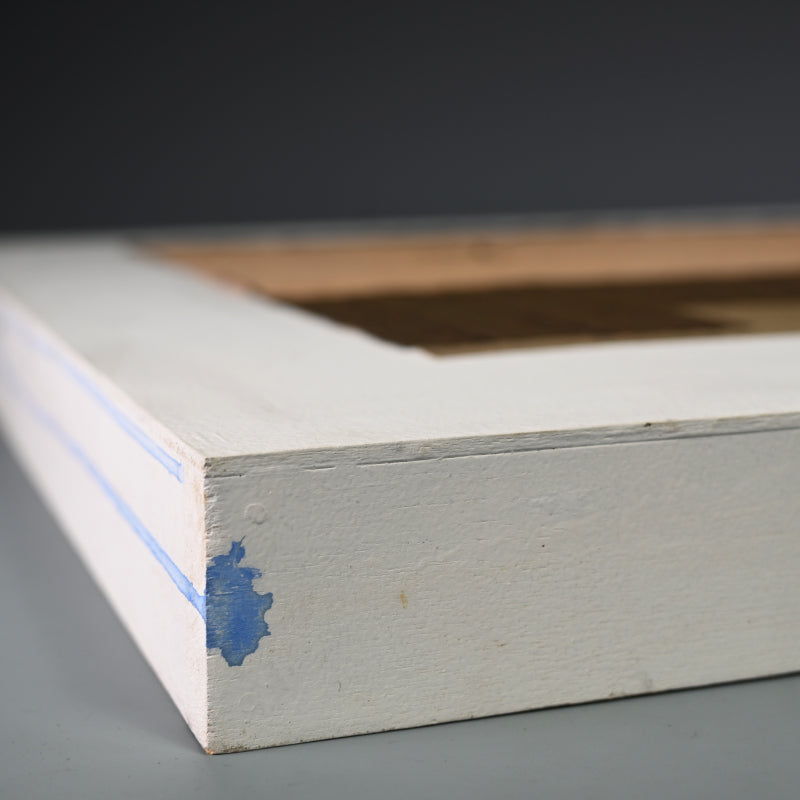
Mixed Media, 1986 ー井田 照一 “Two Elements in Corner of Garden-Love”
Mixed Media, 1986 ー井田 照一 “Two Elements in Corner of Garden-Love”
Item Code: K376
Note: Since this product is an oversized item that requires custom shipping, please send us a message with the delivery address and we will come back to you with a shipping quote.
Couldn't load pickup availability
Various textiles and mud-dyed paper become the ground inlayed with a twig, a seed and a stone, a drip of clear blue beyond the perimeter of this “garden” mounted on a white painted wooden panel by Iida Shoichi singed on the reverse and dating from 1986.It bears the artists original seal on back titled “Two Element in Corner of Garden- Love”. A second seal is from the Holly Solomon Gallery of Fifth Avenue, New York. The panel is 77 x 59 x 5.5 cm ((30-1/4 x 23-1/4 x 2 inches). There are minor handling marks in the white paint, otherwise is in excellent condtion, enclosed in the original cloth bound storage case.
A work from this garden series is currently hanging in the Kyoto Kyocera Museum of Art in tehir retrospective on his life Ida Shoichi—Commemorating the 20th Anniversary of His Passing According to Kyocera: Ida Shoichi (1941–2006) was a leading Japanese printmaker and contemporary artist who redefined the expressive possibilities of printmaking. After completing his studies in Western-style painting at Kyoto City University of Fine Arts (currently Kyoto City University of Arts), Ida gained experience in Paris and New York before establishing an internationally recognized practice in Kyoto. Employing diverse materials such as paper, fabric, and ceramics, he re-examined the surface as a site where matter and image, inside and outside intersect and generate relationships, based on a concept he called “The Surface is the Between.” To mark the twentieth anniversary of the artist’s passing, this exhibition introduces a selection of Ida’s prints alongside works that extend his notion of surface as a liminal space into three dimensions.
Ida Shōichi (1941–2006), based in the city of Kyoto where he was born and raised, was one of Japan’s leading printmakers, active both domestically and internationally.
After graduating in 1960 from the Western Painting course of the Fine Arts and Crafts program at Kyoto Municipal Hiyoshigaoka High School, Ida entered Kyoto City University of Arts (now Kyoto City University of Arts). There, he continued to study oil painting within the Western Painting department. However, he gradually came to feel the limitations of painting in fully expressing the forces and presence of nature that had fascinated him since childhood. It was printmaking that he encountered as a means to resolve this problem. At that time, the university had introduced woodblock and etching classes in 1960 under the sculptor Tsujii Shindō, and from 1963, Yoshihara Hideo and Furuno Yoshio were appointed as lecturers in the Western Painting department, offering intensive printmaking instruction. Immersed in such an environment, Ida eventually taught himself the techniques of lithography and began to develop his career as a print artist.
In contrast to the prevailing trends of the time—typified by the Gutai Art Association, which emphasized individuality, physicality, and emotion—Ida sought to eliminate the artist’s hand and sentiment. Instead, he produced lithographs characterized by bright color and sharply defined forms, attracting attention and invitations to exhibitions such as the Tokyo International Print Biennale. The late 1960s to early 1970s marked the so-called golden age of contemporary Japanese printmaking, and Ida’s early works hold significant importance within this context. He later incorporated silkscreen techniques, and his work took on a distinctly Pop Art sensibility. However, after his stay in Paris from 1969 to 1970, where he encountered figures such as Carl Andre and the composer John Cage, his practice expanded beyond the framework of printmaking into a more experimental realm. Works such as Conception (1974), which fused print and installation, and The Spy Surrounds the Spy (1974), in which fifty distinct images were printed from just two plates, can be understood as Ida’s response to fundamental questions of originality and reproduction—ultimately, to the question of what printmaking itself is.
From these explorations emerged his defining concept of the mid-1970s, “Surface is the Between,” which expresses the idea that the image in printmaking arises in the interval between paper and plate. This concept secured his critical reputation. In Surface is the Between—Between Vertical and Horizon—Descended Triangle–Circle (1987), he employed not only conventional printmaking methods but also the technique of spit-bite aquatint, applying acid directly to the plate by pouring and brushing. Through this process, he recorded in vivid detail the traces of how natural forces act upon materials. Just as acid dropped vertically spreads horizontally, Ida conceived the surface as the point of contact between vertical and horizontal—where time and space intersect. In this way, he achieved indirectly, through the processes of printmaking, what direct depiction in painting could not: an articulation of nature’s presence. Beyond printmaking, he worked with a wide range of materials, including ceramics, bronze, and paper pulp, continually expanding the scope of his practice into his later years. It goes without saying that Ida’s achievements extend far beyond the conventional boundaries of contemporary printmaking.
Share