Note:
Since this product is an oversized item that requires custom shipping, please send us a message with the delivery address and we will come back to you with a shipping quote.
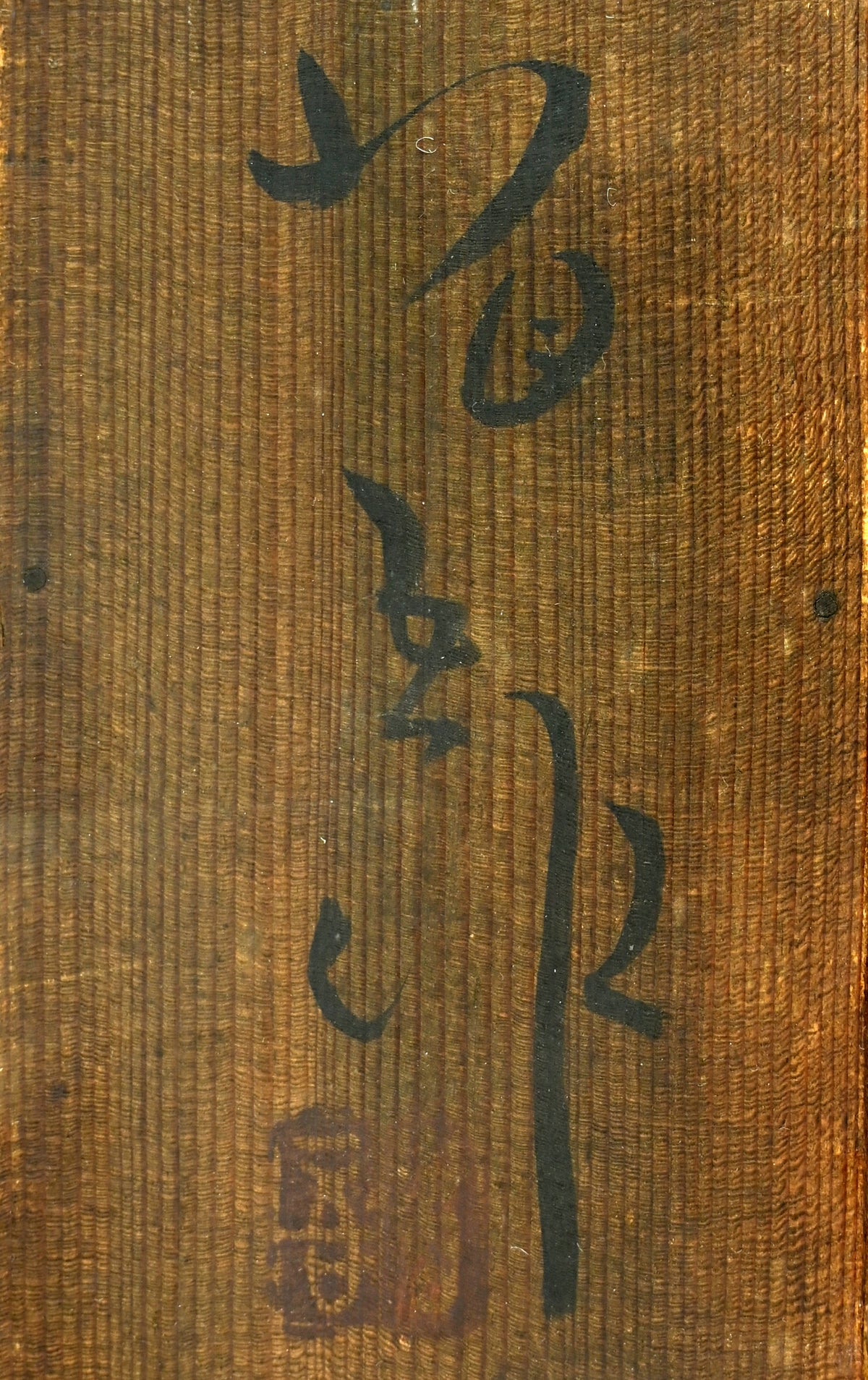
Broad leaves tinged with silver flare open on this small two panel lacquer screen by important 20th century artist Banura Shogo enclosed in the original signed wooden box. It is 182 x 2 x 35.5 cm (7-1/2 x 1 x 14 inches) and is in overall excellent condition, with some tarnishing due to age with a few minor abrasions to the frame typical of age.
Due to size the cost of shipping will be accrued separately.
Banura Shogo (1901-1982) was born in Nanao, Ishikawa prefecture, and studied lacquer in the Wajima tradtion. In 1925 he moved to Kyoto. It was a time of great interest in ancient things, forgotten styles, and revival of lost techniques. Together with Okumura Kyuka he established a research group dedicated to the study and revival of lacquer techniques. He exhibited with the Bunten (Teiten/Nitten) National Art Exhibition and was first awarded there in 1930 for a cabinet, and in 1936 for a screen at the same venue. The following year would see his work garner a prize at the Great Paris Exhibition. Post war he would establish the group Sojinsha which would evolve into Shugenkai in the 1950s. In 1963 e would be granted the Zosho prize from the Japan Art Academy. Ever promoting the field of lacquer, he served as chairman of the Kyoto Shitsugeika Kyokai (Kyoto Association of Lacquer Artists) and was named an Artist of Merit by Kyoto city for his contribution to the arts and crafts in 1972, nad by Kyoto prefecture in 1974. In 1981 this cumlminated wit hteh Order of the Rising Sun , one of the highest national honors for an artist in Japan. He died the following year. Works by him are held in the collections of: The Kyoto National Museum of Modern Art, The Kyoto Municipal Museum of Art, The Tokyo Museum of Modern Art, The Kyoto Shinkin Bank Musuem, Iwashimizu Hachimangu Shrine as well as numerous private collections.