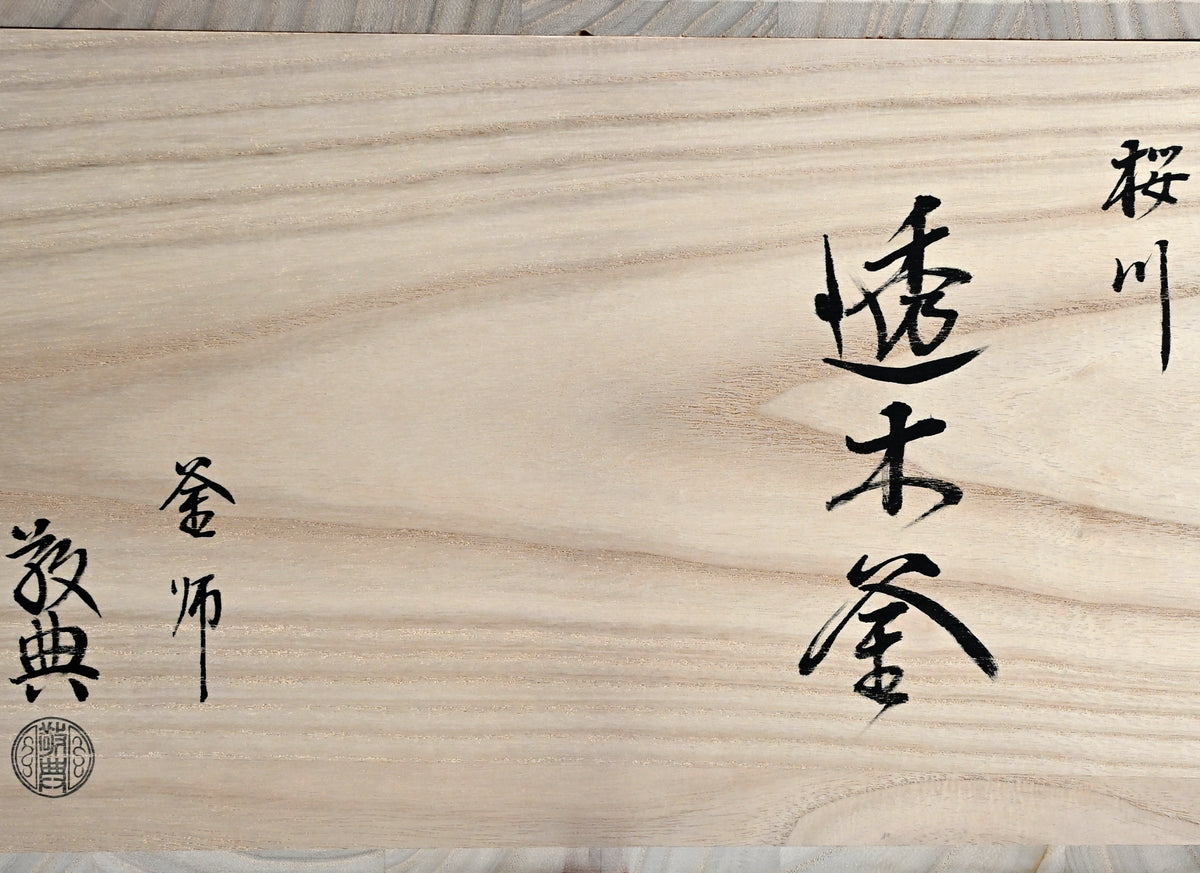
A beautifully proportioned iron Kettle for use in the Japanese Maccha Tea Ceremony by Living National Treasure Takahashi Keiten enclosed in the original signed wooden box titled Sakuragawa sukigi-gama (Iron Tea Kettle with Cherry Blossom River Design). The broad, gently rounded body is encircled by an elegant design punctuated with small cherry blossoms. Finely incised intersecting lines create a rhythmic pattern of triangles and diamonds across the sloping shoulders, their crisp geometry contrasting with the subtly granular texture of the iron, while a broad, slightly undulating flange extends outward from the body, giving the kettle a distinctive silhouette. Two iron ring handles are attached at the shoulders, and a smooth black lid with a sculptural flower-bud finial completes the composition. The kettle is illustrated as No. 61 in Kamashi Takahashi Keiten Jisen Sakuhinshū (Selected Works of Kettle Master Takahashi Keiten), documenting the work within his distinguished career. It is 32 cm (12-1/2 inches) diameter, 22 cm (9 inches) tall and is in excellent condition.
The sukigi-gama is a traditional form of tea kettle distinguished by its broad projecting flange, which allows it to rest upon small wooden supports known as sukigi, placed between the kettle and the supporting edge of the hearth or brazier. This arrangement provides the necessary space for air circulation while supporting the kettle without the use of a conventional iron trivet. The form is particularly associated with the changing seasons of the tea ceremony, when the selection of utensils reflects subtle transitions in the natural world.
The title Sakuragawa introduces an evocative reference to cherry blossoms and flowing water, a familiar poetic theme in Japanese art and literature. Rather than depicting a literal landscape, Keiten expresses the motif through a restrained arrangement of geometric lines and scattered blossoms, allowing the decoration to become an integral part of the iron surface. The result is a work of remarkable compositional balance, combining the disciplined geometry of traditional metal casting with the quiet seasonal sensibility of chanoyu.
Takahashi Keiten (1920–2009) was born in Yamagata City in 1920 and became one of the foremost twentieth-century masters of the Japanese tea kettle. He succeeded to his family's iron-casting business in 1938 and thereafter devoted his career to the creation of chanoyu kama. In 1950 he studied under the distinguished kettle maker Nagano Tesshi I, through whom he deepened his understanding of the great historical traditions of Ashiya and Tenmyō casting, while developing a distinctly modern approach to form and surface. Takahashi first exhibited at the Nitten in 1951 and was accepted seven times before concentrating increasingly on the Japan Traditional Craft Exhibition, receiving its Encouragement Prize in 1963 and the NHK President's Prize in 1976. Working with traditional casting techniques and wazuku, Japanese iron produced from iron sand, he was particularly admired for the quiet refinement of his forms and the subtle treatment of the iron itself, creating elegant surfaces and cast designs whose textures and patterns emerge naturally from the body of the kettle. His achievements brought numerous honors and important commissions: in 1961 he created a presentation kettle for Emperor Shōwa and in 1979 another for the Crown Prince. At a time when Yamagata iron casting remained little known beyond the region, Takahashi actively exhibited his work in Tokyo and elsewhere from the 1950s onward, playing an important role in bringing the long casting tradition of Yamagata to national attention. He received the Order of the Sacred Treasure, Fourth Class, in 1992, and in 1996 became the first resident of Yamagata Prefecture to be designated a Living National Treasure, recognized as holder of the Important Intangible Cultural Property “Tea Ceremony Kettle”. Through a lifetime devoted to the kama, Takahashi brought together the austere beauty of historic Japanese iron casting with an inventive sensitivity to form, texture and pattern, establishing Yamagata casting firmly within the modern history of Japanese metalwork.