Note:
Since this product is an oversized item that requires custom shipping, please send us a message with the delivery address and we will come back to you with a shipping quote.
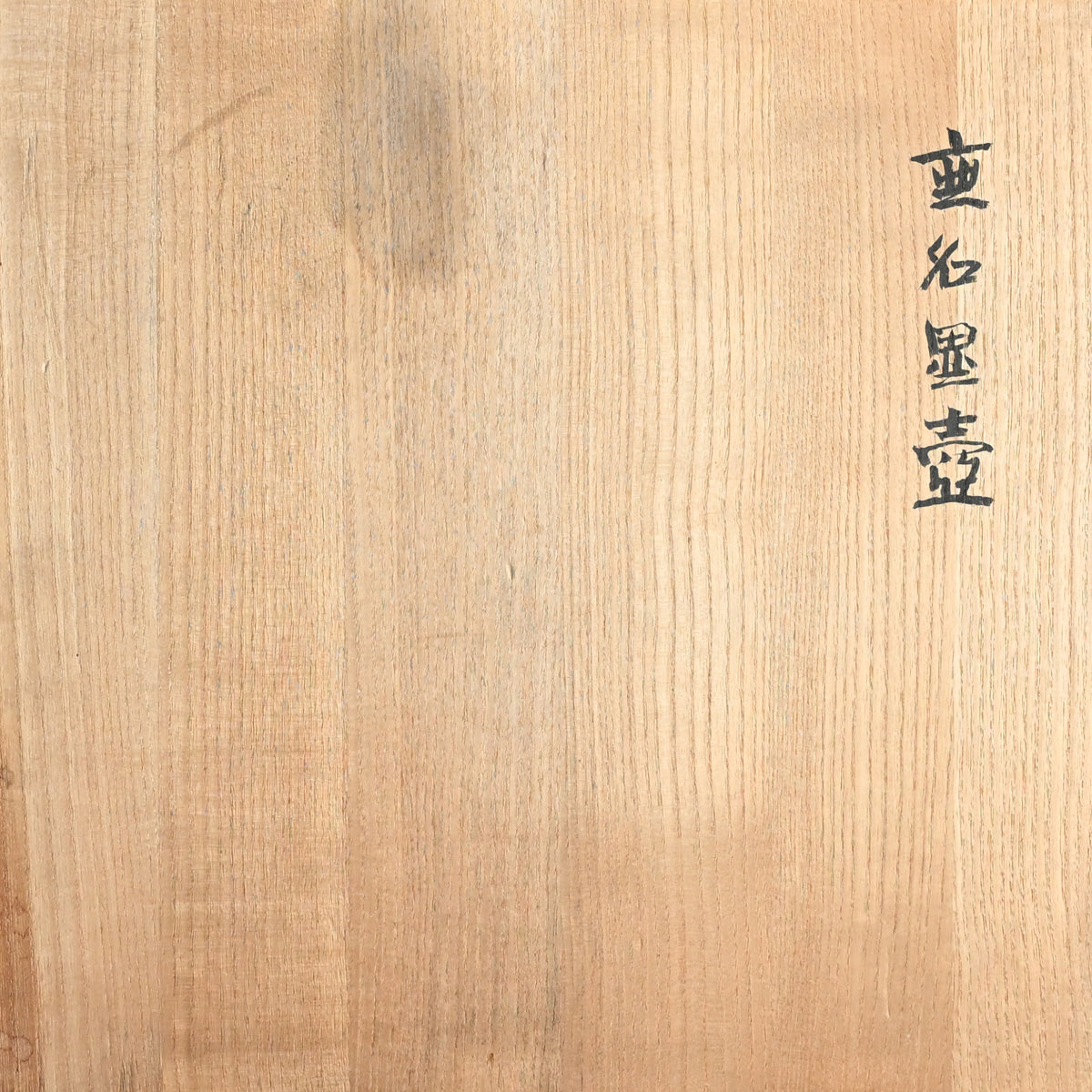
A monumental Mumyōi-yaki vessel by Living National Treasure Itō Sekisui V, enclosed in the original signed wooden box titled Mumyōi Tsubo. Among the largest works we have encountered by the artist, the broad spherical body rises almost seamlessly to a small recessed mouth, giving the vessel a remarkably pure and sculptural silhouette. The lower body retains the intense iron-red color of Sado's mumyōi clay, while the upper portion has been transformed through firing to a smoky charcoal-grey, the two fields meeting along a sweeping, softly diffused boundary that travels around the vessel like a distant horizon. The finely textured matte surface and complete absence of applied decoration place all emphasis on color, material and form, revealing the extraordinary range Itō could achieve from this distinctive Sado clay alone. His impressed mark appears on the base. The vessel measures 33.5 cm (13-1/4 inches) in diameter and 31 cm (12-1/4 inches) tall and is in perfect condition.
Due to size the cost of shipping will be accrued separately
Mumyōi is an iron-rich mineral found within the Sado Gold and Silver Mines. Mumyōi ware is produced by incorporating this mineral into ceramic clay and firing it at high temperatures. The history of Mumyōi pottery begins in 1819 (Bunsei 2), when Itō Jinpei produced raku ware using mumyōi clay obtained from the tunnels of the Sado Gold Mine. The clay itself is refined through a process known as suihi (water levigation), a refining process in which clay is suspended in water and filtered to remove sand and other impurities, producing an exceptionally fine clay body suitable for ceramic production. Because the resulting clay consists of extremely fine particles, it undergoes significant shrinkage—approximately 30 percent—during firing. As a result, the finished ware is exceptionally hard. When struck, it produces a clear, resonant metallic tone, and with continued use it develops an increasingly lustrous surface. One of the distinctive features of Mumyōi ware is the use of specialized finishing techniques, including meticulous burnishing during production and abrasive polishing with sand after firing.
Ito Sekisui V (Yoichi) is the 14th generation of the family to follow in the pottery tradition. His father, Ito Sekisui IV, died when Yoichi was only 19. Upon completion of studies at Kyoto University in 1966, he returned to his hometown of Sado to succeed the lineage. His work was displayed for the first time at the Nihon Dento Kogeiten (National Traditional d Crafts Exhibition) in 1972. The following year he won first prize at the Nihon Togeiten (Japan Ceramic Art Exhibition). In the 1980s, Sekisui V started to create neriage (mixed clay) works as well as his family's traditional mumyoi-yaki pieces, and in 2003 he was appointed a Living National Treasure for his work in these fields.