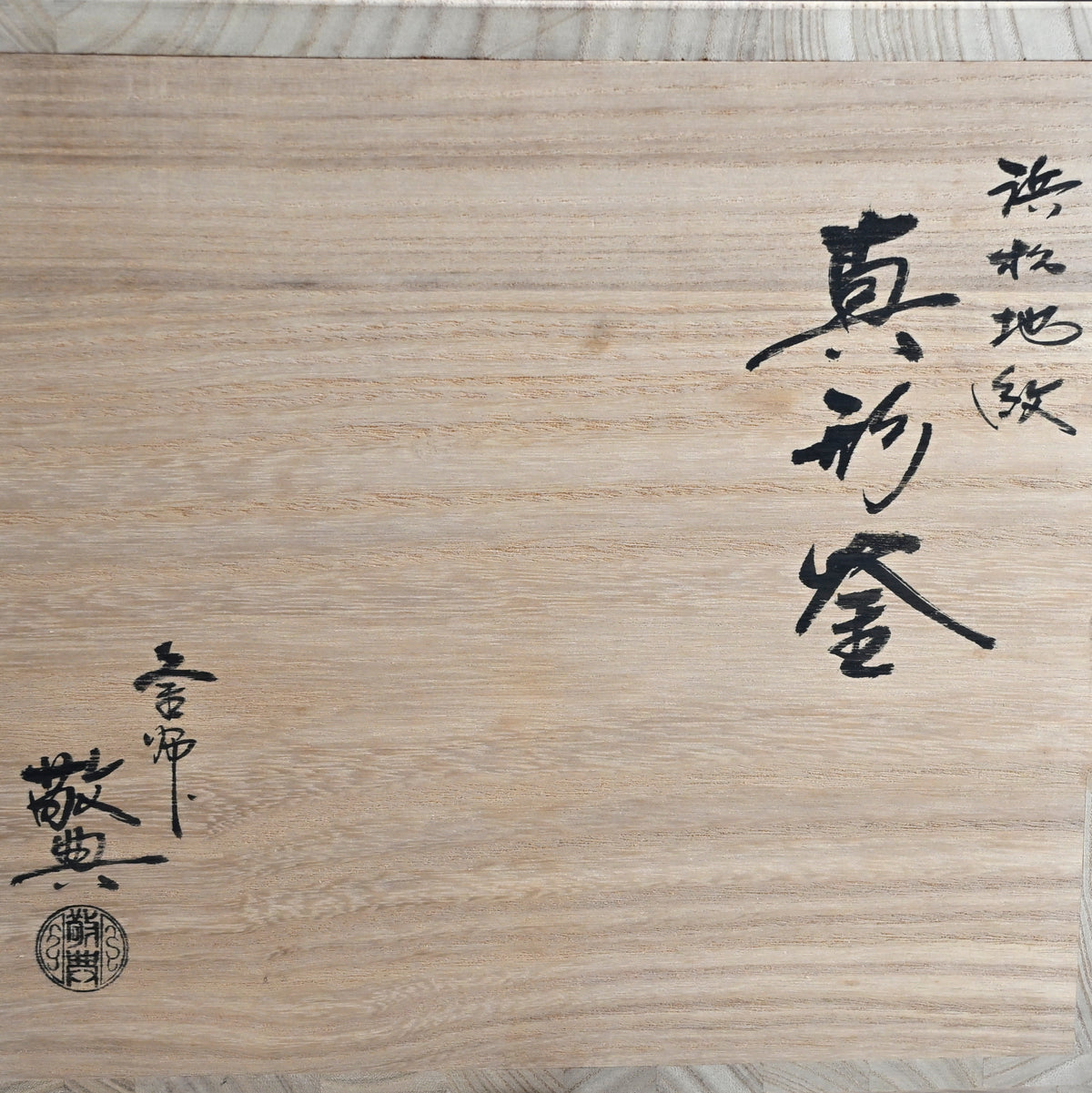
An elegant iron Kettle for use in the Japanese Maccha Tea Ceremony by Living National Treasure Takahashi Keiten enclosed in the original signed wooden box titled Hamamatsu Jimmo Shinnari-gama (Iron Tea Kettle with Pine Trees along the Shore). Its beautifully rounded body is decorated with a subtle design of pine trees growing along a shoreline cast in low relief upon the finely textured iron surface, the slender trunks and sweeping branches emerge almost imperceptibly from the dark, softly mottled ground, suggesting a windswept coastal landscape. A narrow band of stippled texture encircles the lower body, while the gently sloping shoulders rise toward a relatively small opening fitted with a beautifully patinated bronze lid, its sculptural knob fashioned as a flower bud. The restrained composition, contrasting textures, and carefully balanced proportions exemplify Keiten's mastery of traditional Japanese iron casting. The work is illustrated as No. 47 in Kamashi Takahashi Keiten Jisen Sakuhinshū (Selected Works of Kettle Master Takahashi Keiten). It is 24.5 x 25 x 21 cm (9.6 x 9.8 x 8.3 inches) and is in perfect condition. The accompanying outer cardboard box bears a date of November 1992, four years before Keiten's designation as a Living National Treasure.
The shinnari-gama is considered one of the most fundamental forms of Japanese tea kettle, its origins traditionally traced to the Ashiya casting tradition of Chikuzen during the early Kamakura period (1185–1333). Developed for heating water over a portable brazier, its characteristic form combines a rounded body, gently sloping shoulders, a slightly inward-curving mouth, and a projecting flange around the lower body. Over the centuries, the shinnari became an enduring model for kettle makers, its deceptively simple form offering considerable scope for refinement of proportion and surface.
Takahashi Keiten (1920–2009) was born in Yamagata City in 1920 and became one of the foremost twentieth-century masters of the Japanese tea kettle. He succeeded to his family's iron-casting business in 1938 and thereafter devoted his career to the creation of chanoyu kama. In 1950 he studied under the distinguished kettle maker Nagano Tesshi I, through whom he deepened his understanding of the great historical traditions of Ashiya and Tenmyō casting, while developing a distinctly modern approach to form and surface. Takahashi first exhibited at the Nitten in 1951 and was accepted seven times before concentrating increasingly on the Japan Traditional Craft Exhibition, receiving its Encouragement Prize in 1963 and the NHK President's Prize in 1976. Working with traditional casting techniques and wazuku, Japanese iron produced from iron sand, he was particularly admired for the quiet refinement of his forms and the subtle treatment of the iron itself, creating elegant surfaces and cast designs whose textures and patterns emerge naturally from the body of the kettle. His achievements brought numerous honors and important commissions: in 1961 he created a presentation kettle for Emperor Shōwa and in 1979 another for the Crown Prince. At a time when Yamagata iron casting remained little known beyond the region, Takahashi actively exhibited his work in Tokyo and elsewhere from the 1950s onward, playing an important role in bringing the long casting tradition of Yamagata to national attention. He received the Order of the Sacred Treasure, Fourth Class, in 1992, and in 1996 became the first resident of Yamagata Prefecture to be designated a Living National Treasure, recognized as holder of the Important Intangible Cultural Property “Tea Ceremony Kettle”. Through a lifetime devoted to the kama, Takahashi brought together the austere beauty of historic Japanese iron casting with an inventive sensitivity to form, texture and pattern, establishing Yamagata casting firmly within the modern history of Japanese metalwork.