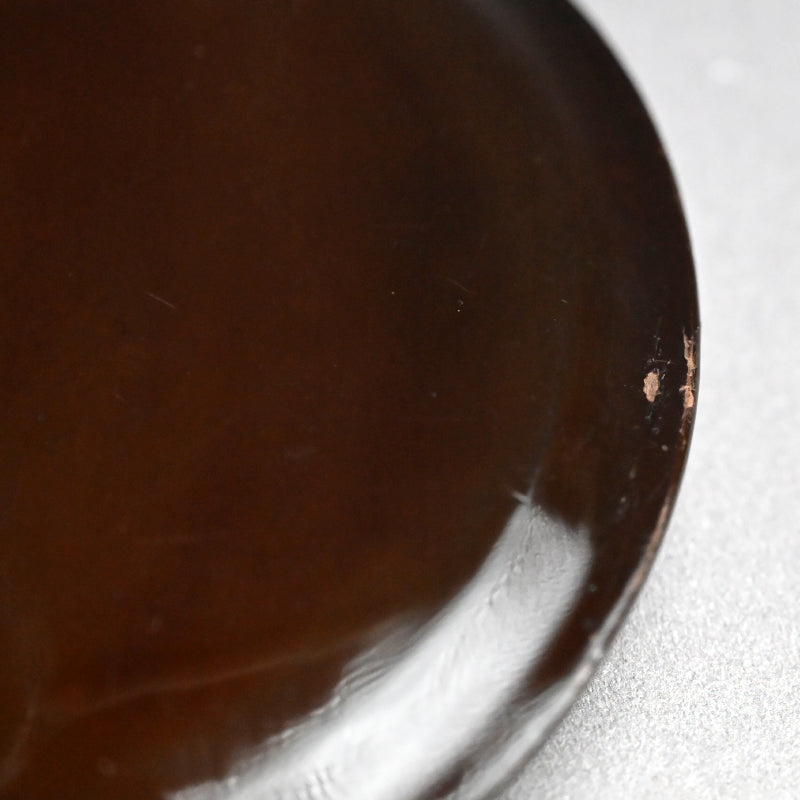
Popular in Buddhist Maccha Tea Circles in the Edo period, this recovered Tokoname Fushiki pot, very roughly fired, dates from the mid to late Kamakura period (1192-1333), but was unearthed and used as a Mizusashi fresh water jar during the earlier Edo era. There is an old heart shaped black lacquered tsukui-buta (concave) wooden lid mellowed to a chocolate color with age. The jar is 22 x 19 x 16.5 (8 x 7-1/2 x 6-1/2 inches) and comes enclosed in an ancient Kiri-wood box. The Fushiki (Beyond Comprehension) Jars are named after the Daruma, who described himself as Fushiki when inquired upon by the Chinese Emperor. The most famous of the Fushiki Jars is that of Sen no Rikyu. In the traditional Zen account as laid down in the Zen classic The Gateless Gate, Emperor Wu of Liang, inquires of Bodhidharma (Daruma) : "Who is standing before me?" to which the Daruma replied only fushiki.
The term literally means "I do not know," "not knowing," or "unknown." It is not exactly a personal name. Rather, Bodhidharma's response is understood in Zen as a rejection of fixed identity and conceptual classification. When the emperor asks "Who are you?", he expects a conventional answer—a monk, a teacher, an Indian sage. Bodhidharma instead answers from the standpoint of emptiness and non-attachment: the true self cannot be grasped or defined. This famous response became an important Zen phrase. In the tea world, such a name evokes humility, the limits of intellectual knowledge, and the Zen insight that ultimate reality lies beyond verbal explanation.