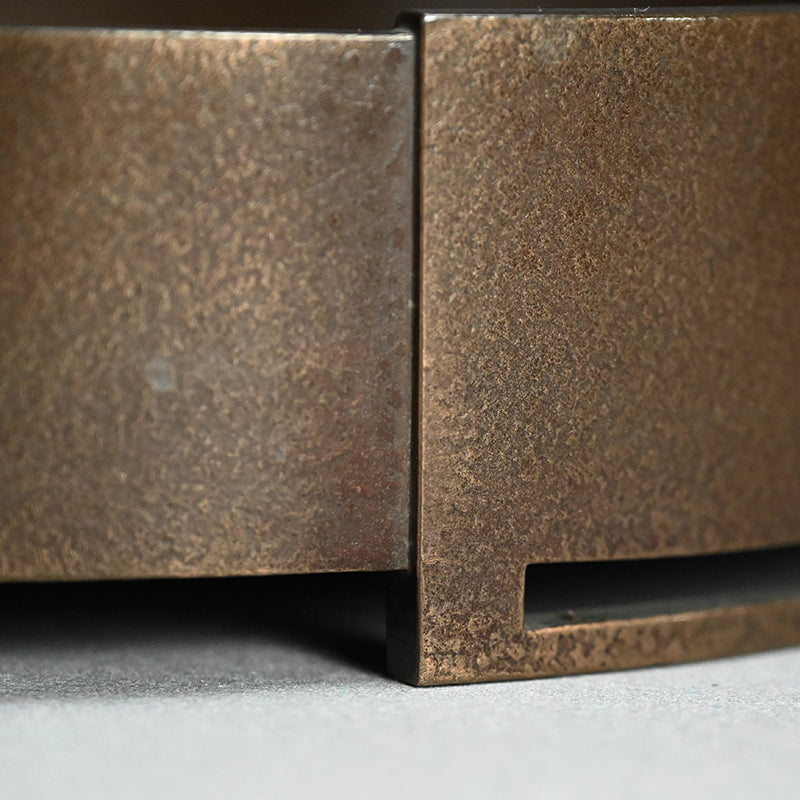
A heavy bonze basin in orange-peel texture with an architectural presence showcasing the art-deco aesthetic of the 1920s and 30s. Signed on the base in an incised seal, it is 32.5 cm (13 inches) diameter, 7 cm (3 inches) tall and weighs 6.25 kg (13-1/2 pounds) and is in overall excellent condition.
Art Deco emerged in the years surrounding the 1925 Exposition Internationale des Arts Décoratifs et Industriels Modernes in Paris, seeking to reconcile ornament with modernity through a visual language of geometry, stylization, and a rigorously “designed” elegance. Cosmopolitan and emphatically urban, it celebrated speed, luxury, streamlined form, and an international visual vocabulary that drew on Cubism, Egyptian archaeology, African and Oceanic form, avant-garde fashion, and—crucially—Japan. French designers looked to Japanese lacquer and decorative arts as models of refinement achieved through restraint: the sheen of lacquer, the purity of silhouette, and the expressive power of omission became central to Deco’s idiom, and many believed Japan had invented a modernity of surfaces before Europe did. By the late 1920s these ideas had begun to circulate back to Japan, where Deco entered the new metropolitan culture of Tokyo and Osaka not as a foreign style but as something already intuitively legible. It illuminated values long embedded in Japanese aesthetics—clarity of line, disciplined luxury, and the sense that refinement is a moral as well as stylistic category—and Japanese artists adapted the style into a more poetic, less ostentatious mode that remained equally modern. The exchange became reciprocal: Japan had helped shape Deco at its inception, and Deco in turn gave Japan a new vocabulary through which to articulate a distinctly modern sensibility. Its influence persisted well beyond the war years, informing postwar studio crafts—glass, lacquer, cloisonné, and metalwork—with a sensibility of essential form, quiet geometry, and abstraction understood not as rebellion but as serenity. In this sense, the history of Art Deco and Japan is not a peripheral aspect of Western modernism but a dialogue in which Japanese visual logic both seeded and later reabsorbed the movement, using it as a bridge to articulate Japan’s own twentieth-century modernity.