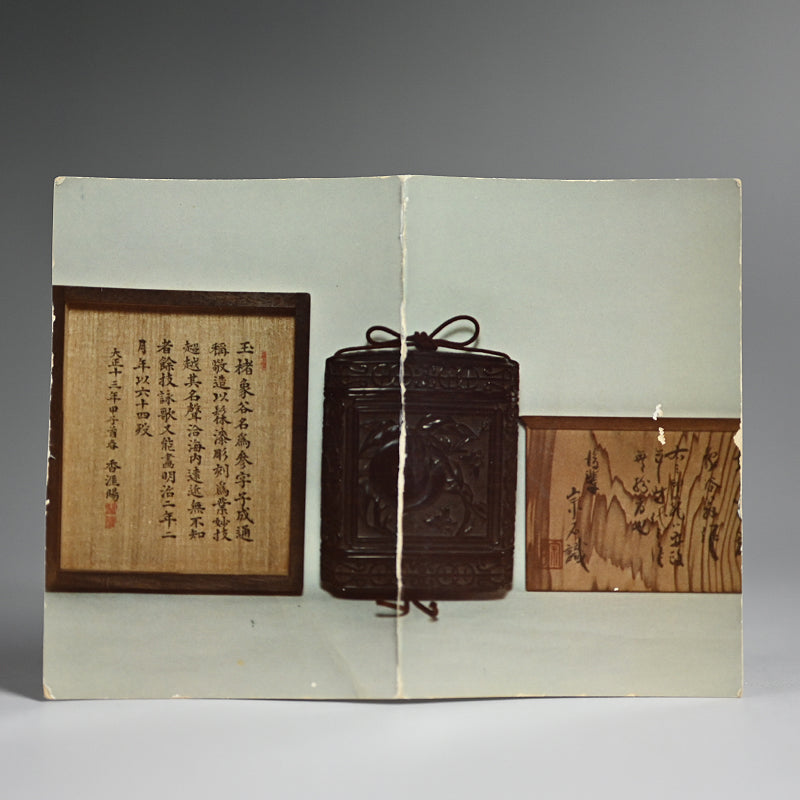
A spectacular carved lacquer inro by Tamakaji Zokoku enclosed in a spectacular double wood box held in a cloth bound sleeve. The inner wood box is of fine straight grained wood joined with lightning cuts to darkwood at the joint between lid and box. Inside Is a long epitaph recording the life of Zokoku dated Taisho 13 (1924). This is in turn enclosed in a box of cross cut cedar with an epitaph inside signed Soseki. All of this fits into a cloth bound box with silk covered door. The inro is 8.5 x 4 x 9.5 cm and is in excellent condition. This piece is featured on page 110 figure 42 of the book Hyakunensai Kinen Tamakaji Zokoku produced in 1968 on the 100th anniversary of his passing. It is also published on page 65 of the book Kagawa no Nuri Kogei.
The production of lacquer-ware in Kagawa (Shikoku) was encouraged by the feudal lord Yorishige Matsudaira (1622-1695) and many artisans took up residence in the area. Tamakaji Zokoku was an important artist in the development of modern Kagawa lacquer art. Born in Takamatsu City, Kagawa, in 1806, at a young age he went to Kyoto where he studied painting as well as lacquer technique. Zokoku was granted access to many important collections of antique lacquer works including works from countries such as China, Thailand, and Myanmar in the possession of Higashi-Honganji Temple and Daitokuji Temple. After returning to Takamatsu his talent was recognized by Matsudaira Yorihiro (ninth lord of the Takamatsu Domain), and he was appointed to manage the items in the domain's treasury. He carefully researched each of these treasures to further develop his own skills. He established a distinctive style of lacquer-ware based on his interpretation of these traditional techniques. Today, these form the basis of the three major Kagawa Lacquer ware Techniques, Kinma, Zonsei, and Choshitsu.