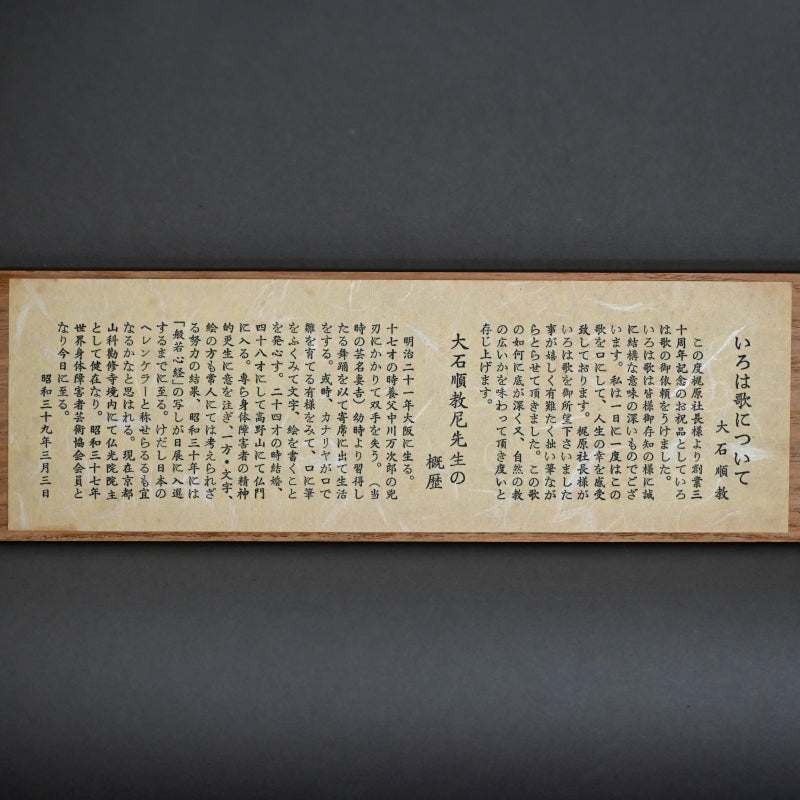
Golden characters fall like rain down this calligraphy work by Buddhist Nun Oishi Junkyo enclosed in the original signed wooden box containing an explanation of the poem and biography of Junkyo dated 1964. Gold on blue paper mounted in beige silk extended with light blue and featuring festive red lacquered wooden rollers. It is 33 x123 cm (13 x 49 inches) and is in excellent condition.
Junkyo’s life is a triumph over tragedy. Born into a low family, she was sent to a tea house where she became an apprentice Geisha. In a famous incident, the Tea House owner in a drunken rage murdered 5 of the Geisha, and cut off both of Junkyo’s arms. She survived. Becoming then a teller of stories and singer, she one day saw a bird feeding her young, and realized she could paint if she used her mouth to hold the brush. She enrolled into a studio, and became an accomplished painter in the Nihonga tradition. She then married and had two children, but later divorced, raising the two children alone. She became a nun, and opened a counseling/self-help center for the disabled. This was the war years, and the midst of Japan’s industrial revolution. Both mishaps in the machinations of industry and battle kept her half-way house filled with people in need. After the war she established a temple, and continued her philanthropic work.
The Iroha is one of Japan’s most famous poems, and it has held both cultural and spiritual significance from the Heian period onward. Colors are fragrant, but they fade away. Who in this world can remain unchanged? Today let us cross the deep mountains of existence, and not be led astray, nor intoxicated by illusion. It is often read as an allegory of Buddhist thought, especially the Zen emphasis on the fleeting nature of human existence. The opening line, “Colors are fragrant, but they fade away” expresses the transience of beauty and life, while it concludes with “We shall not be deluded, nor be intoxicated, a call to live without clinging to illusion. the poem contains each kana of the Japanese syllabary exactly once (a perfect pangram).