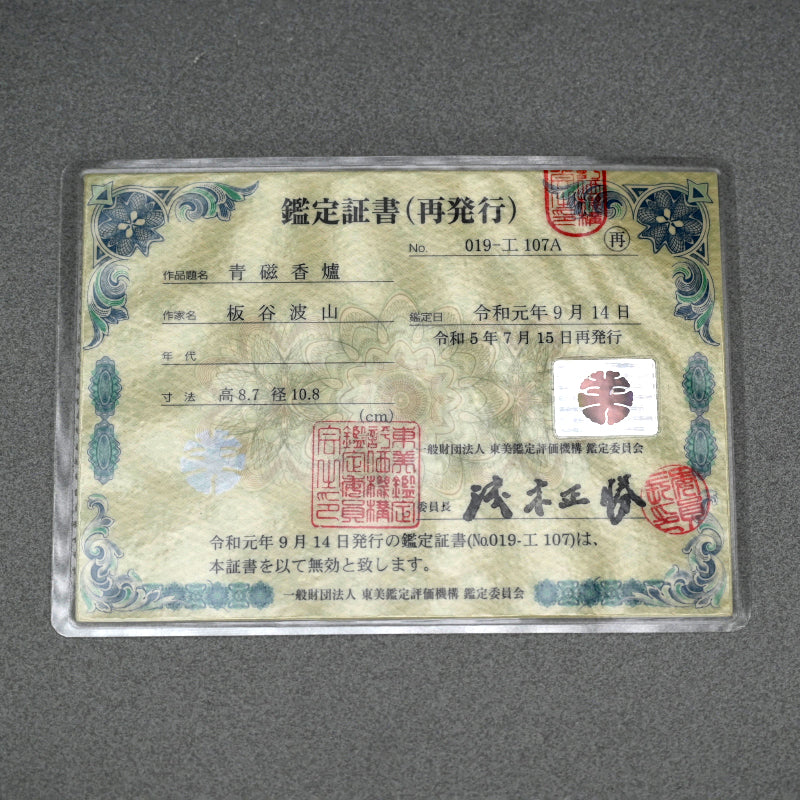
A masterfully crafted incense burner on three legs in crackled celadon glaze by Teishitsu Gigeiin (Imperial Artist) Itaya Hazan enclosed in the original signed wooden box titled Hyokaji Koro. It retains the original pierced rose-wood lid with stone finial. The koro is 11 cm (4-1/2 inches) diameter, 8.5 cm (3-1/2 inches) tall and is in perfect condition. The box signed box is in turn enclosed in a protective outer black lacquered wooden box (Ni-ju Bako) and the work comes accompanied by a certificate of authenticity from the Tokyo Bijutsu Kurabu (no. 019-107A).
Itaya Hazan (1872-1963) was born in Ibaraki, given name Kashichi, 8th son of a wealthy merchant. He entered the Tokyo Art School in 1889 where he studied sculpture under Takamura Koun and Okakura Tenshin, then took a job teaching sculpture at the Ishikawa Prefectural Industrial School where he stayed until the school closed in 1898. This gave impetus and time for a life altering course change, and he began to study traditional ceramics. It was in 1903 that he moved to Tokyo and assumed the name Hazan. Hazan was one of the first artists to integrate ceramics as a craft and the European idea of fine art (along with fellow Teishitsu Gigein Ito Tozan) incorporating Art Nouveau into his more traditional designs, and he would take top prize in 1911 at the National Ceramics Exhibition. Shortly thereafter, in protest to the growing commercialization of the National Exhibitions, he withdrew from that world, concentrating on the idea of pottery as a branch of the fine arts (not officially recognized in Japan as such until 1928). In 1927 he became one of only five potters ever named a member of the prestigious Imperial Art Academy (Teishitsu Gigeiin). In 1954, Hazan became the first potter to be awarded the Order of Culture (Bunka Kunsho, and shortly before his death, like the great Artists Kitaoji Rosanjin and Kawai Kanjiro, he rejected the title Living National Treasure (Mukei Juyo Bunkazai).