Note:
Since this product is an oversized item that requires custom shipping, please send us a message with the delivery address and we will come back to you with a shipping quote.
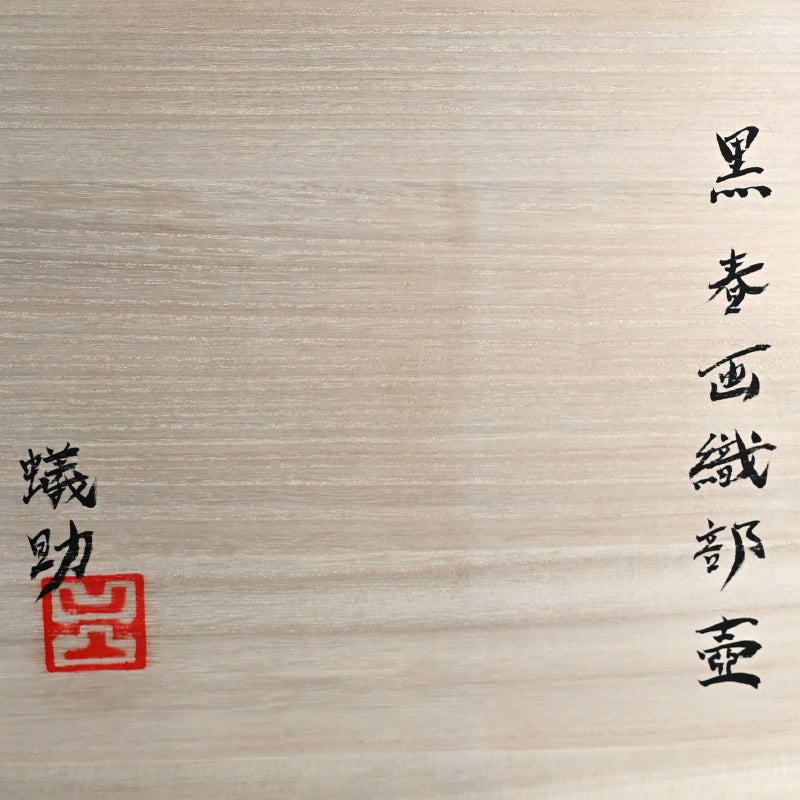
This monumental Shunga Tsubo” by Fukami Fuminori represents one of the artist’s most provocative explorations of the Manga Oribe idiom enclosed in the original signed wooden box titled Kuro Shunga Oribe Tsubo. The form is robust, recalling the powerful silhouettes associated with early Oribe ceramics, possessing a broad, swelling body rising to a thick, slightly flared mouth. The surface is divided into contrasting pictorial zones. A richly textured black Oribe ground wraps around much of the vessel, punctuated by circular reserves and small red star motifs. Emerging from this dark field is a large illustrated panel in warm earthen tones depicting two embracing female figures rendered in a manga-inspired style. Their playful horns, wings, and stylized features evoke demonic or supernatural beings drawn from Japanese folklore, yet interpreted through contemporary graphic aesthetics. The imagery carries clear echoes of Edo-period shunga (erotic art) traditions, where sensuality, humor, and fantasy often intertwined. Fukami deliberately intensifies the dialogue between past and present. The graphic line work and expressive figures recall the bold outlines of ukiyo-e woodblock prints, while the exaggerated anatomy and playful iconography reveal the influence of modern manga illustration. The artist signs works from this series under the pseudonym Shikiyokusai Arisuke. This practice consciously references the Edo-period custom in which artists of erotic prints adopted alternate signatures, protecting their reputations and patrons in an era when such imagery was often officially discouraged. By reviving this convention, Fukami not only acknowledges the historical lineage of erotic imagery in Japanese art but also situates his work within that tradition while reinterpreting it for the present. The vessel is 35 cm (14 in.) diameter, 40 cm (16 in.) itall and in excellent condition this large vessel stands as a powerful and museum-worthy example of Fukami Fuminori’s Shunga Oribe series, where tradition, satire, sensuality, and craftsmanship converge on the monumental surface of clay.
Due to size the cost of shipping will be accrued separately.
Fukami Fuminori was born in 1980 in Seto, Aichi Prefecture, one of Japan’s historic centers of ceramic production. He graduated from the Seto Ceramic Training School in 2000 and the following year began a four-year apprenticeship under the potter Kishimoto Kennin. He established himself as an independent artist in Seto in 2005. Originally he began copying imagery from Hokusai’s Manga sketchbooks onto ceramic vessels, which led him to experiment with images from other ukiyo-e artists such as Utagawa Kuniyoshi. As he continued painting, he gradually incorporated imagery reflecting his own designs and contemporary cultural influences, leading to the distinctive visual language seen in his work today. Known for bold and innovative designs, Fukami creates works that are both unconventional and singular. The terms Manga Oribe and Shunga Oribe are expressions coined by the artist himself. Because vessels, tea utensils, and flower vases are curved surfaces, accurately depicting the human figure can be difficult; however, Fukami considers this distortion to be part of the charm and expressive potential of the medium. He continues to search for imagery that harmonizes with the clay body and the form of each piece. While his works titled Manga Oribe have attracted particular attention, he has also produced notable pieces in traditional Mino styles such as Kiseto and Shino. He received the Chairman’s Prize at the Seto City Art Exhibition and has been selected for both the Tokai Dento Kogeiten Traditional Crafts Exhibition and the Gendai Shato Ten National Contemporary Tea Ceramics Exhibition.