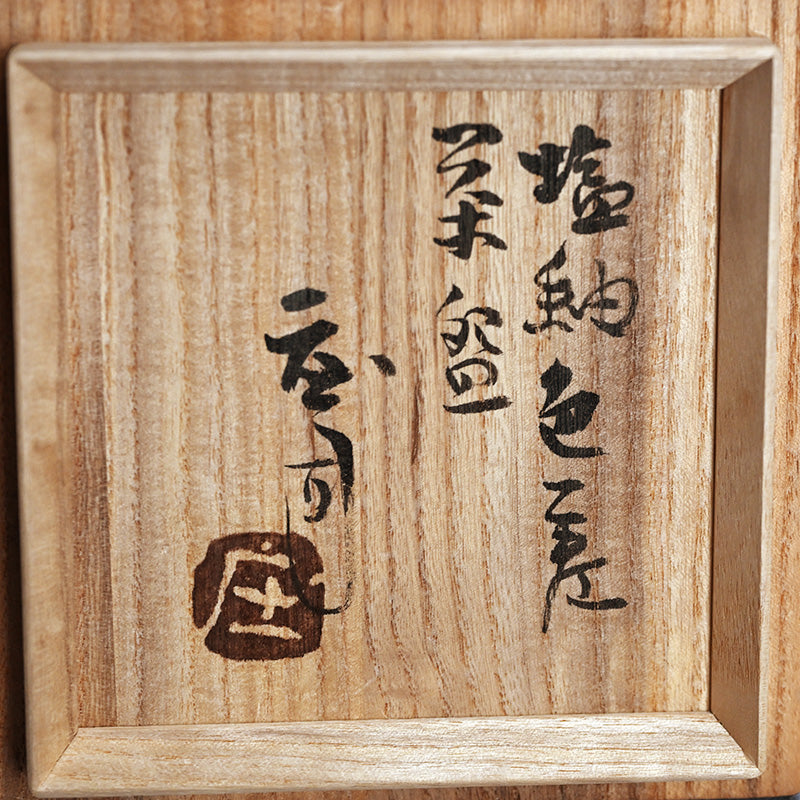
A superb salt-glazed tea bowl by Living National Treasure Hamada Shōji, enclosed in its original signed wooden box titled Shio-yū Irosashi Chawan. Deeply formed in the classic wan-gata shape, the bowl rises from a compact foot into a full rounded body before opening at a gently irregular rim. Its quiet form provides the ground for an exceptionally lively surface, where the salt firing has produced a translucent grey-green glaze of remarkable texture, densely speckled and subtly pitted, with the granular character of the clay remaining visible beneath. Across this muted surface Hamada has applied a sparse rhythm of color: brilliant pools of cobalt blue alternate with warm iron-brown marks, while broad, almost translucent strokes of pale slip sweep vertically and diagonally around the body. Some appear as simple bands; others broaden and turn as they cross the curve of the bowl. The colored accents seem almost suspended within this loose framework, appearing and disappearing as the vessel is turned. Particularly effective is the cobalt, whose sudden intensity punctuates the subdued grey surface without overwhelming it. The interior is left comparatively restrained, its warm grey-beige glaze revealing the concentric traces of throwing and allowing the eye to settle after the movement of the exterior. Below, the substantial foot is roughly finished, with small areas of warm reddish clay exposed where the glaze withdraws. The contrast is characteristic of Hamada at his most assured: coarse clay and salt glaze, loosely applied slip and only a handful of colored marks are brought together without fuss, each material allowed to retain its individual character. It is 12.5 cm (5 inches) diameter, 9 cm (3-1/2 inches) tall and in perfect condition.
Salt glazing held particular significance for Hamada. He had encountered the tradition in England during his years with Bernard Leach at St Ives, where the technique had long European precedents, and later incorporated it into the vocabulary of his Mashiko pottery. Rather than imitating European salt-glazed stoneware, however, Hamada absorbed the process into his own language of Japanese vessel forms, spontaneous decoration and locally rooted materials. In this chawan, the characteristic slightly rough, glassy salt surface becomes a particularly effective ground for his irosashi decoration.
Hamada Shoji was born in Kanagawa Prefecture in 1894. In 1913, at the age of 19, he entered the Ceramics Department of the Tokyo Higher Technical School (now the Tokyo Institute of Technology) where he formed a friendship with senior student Kawai Kanjiro. In 1918 after visiting an exhibition, Yanagi Soetsu introduced him to the important British potter Bernard Leach, and the history of ceramic art was forever changed. The following year, he moved to England with Leach where he lived in St. Ives. After returning to Japan (1924), he spent time in Okinawa studying and appreciating the Tsuboya pottery of the island region. He then stayed with Kanjiro in Kyoto, where he, Yanagi, and Kanjiro established the principles of the Mingei movement. Hamada then chose to establish his own kiln in the sleepy northern town of Mashiko. He worked incessantly to further the Mingei ideals, using local clays and materials, and became mentor to any number of artist both domestic and from abroad. He was named a Living National Treasure in 1955. One of the most influential and sought after of all Japanese Ceramic artists.