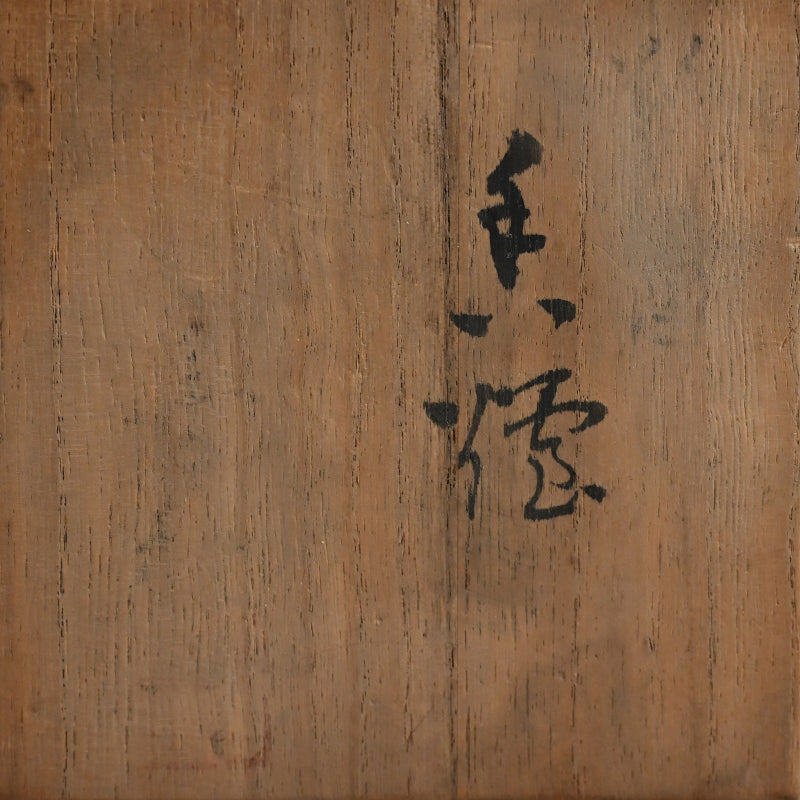
A refined lidded form cut from a single Agate stone finely polished in natural color from the Wakasa region, the origin of gem-stone cutting in Japan. It is roughly 11 cm (4-1/4 inches) diameter, the same height and is in perfect condition and is enclosed in a period wooden box simply titled Koro.
Agate has long been revered in Buddhism—appearing in the Infinite Life Sutra as one of the “Seven Treasures” that adorn the Pure Land. In Japan, Wakasa agate carving is regarded as one of the roots of gemstone craftsmanship in Japan. It is said that the origins of agate craftsmanship date back to the Nara period in present-day Onyū in Wakasa, Fukui Prefecture—a region centered around one of Wakasa’s famous shrinesi. At that time, a seafaring people known as the Wani clan, who revered jewels, came to this area. They established a route called the Wani Road in front of the shrine and made the production of beads their livelihood, which is considered the beginning of the tradition. The origins of the modern techniques of Wakasa agate craftsmanship date back to the early 18th century when a man named Takayama Kichibē, who had trained while working for an optician in Naniwa (present-day Osaka), returned to Wakasa and began producing agate beads based on the techniques he had learned. A major transformation occurred in the early Meiji period. Nakagawa Heisuke, an artisan of Wakasa agate, sought to expand beyond simple bead-making and explore broader expressive possibilities using agate. Through his innovations, the craft evolved to include sculptural works and other carved objects, opening a new path for agate as an artistic medium. As the range and artistic quality of the works expanded, Wakasa agate pieces were exhibited at expositions across Japan and eventually gained international recognition. In 1976 (Shōwa 51), the craft was officially designated as a Traditional Craft of Japan.