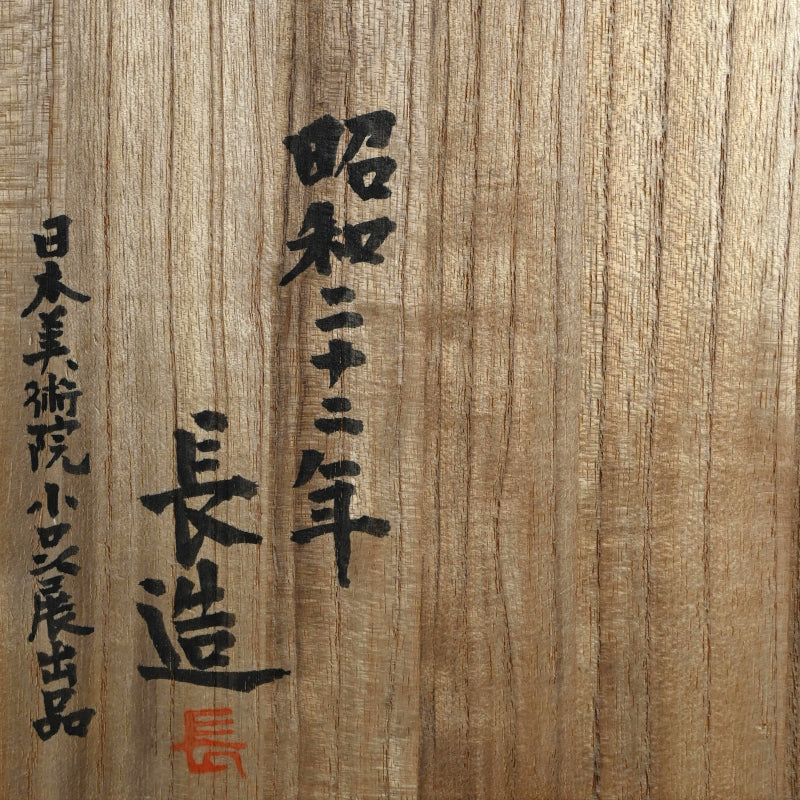
A rabbit formed using the dry lacquer techniqueby Seki Chozo extreme;ly close to the Rabbit by him held in the Takaoka Art Museum enclosed in the original signed wooden box dated 1947 and annotated as having been exhibited at the Nihon Bijutsuin Sho-hin Ten National Exhibition held briefly in the immediate post war era. The creature is 23 x 13 x 17.5 cm (9 x 5-1/4 x 7 inches) and is in excellent condition. Despite its size, due to the method of creation, it weighs only 508 grams (1 pound).
Seki Chōzō (1913–1976) was a sculptor from Takaoka City, Toyama Prefecture, active during the Shōwa period. He worked primarily within the sculpture division of the Japan Art Institute and is regarded, alongside fellow Toyama sculptors such as Matsumura Hidetarō and Oyaizu Saburō, as one of the region’s representative artists. Employing a wide range of techniques—including dry lacquer (kanshitsu), carving, metal sculpture, and drawing—Seki produced numerous works, particularly sculptures and studies of the female nude. His notable works include Rabbit (1944, Takaoka Art Museum), a key example of his dry lacquer practice, and the Seated Statue of Zen Master Eisai of the Rinzai School, created as part of the “Seven Patriarchs of Buddhism” installation at Yomiuri Land’s Sacred Park. His works are held in public collections such as the Takaoka Art Museum and the Toyama Prefectural Museum of Art and Design, and continue to be exhibited and studied in the context of regional modern sculpture.
The Nihon Bijutsuin (Japan Art Institute) is familiar to many as the “Inten,” the name of the biannual painting exhibition which it organizes and promotes. The Nihon Bijutsuin was founded in 1898 under the primary guidance of Okakura Tenshin, based on his philosophy and ideals. He promoted respect for Japanese cultural traditions (and the importance of preserving cultural properties) but also sought a path to the future by encouraging new developments in Japanese art. There were 26 founding members altogether. In 1914, on the first anniversary of Tenshin’s death, a “Revival” of the organization was led re-establishing its goals: free and open research into the arts. Exhibitions were organized from then annually until the present, next year will be the 111th. Following the second world war, the Japan Art Institute Small Works Exhibition, was inaugurated in November 1945 at Nihonbashi Mitsukoshi. Alongside this early initiative, the Reconstructed Inten Exhibition (the continuation of the pre-war Inten) developed as a major open-call exhibition held annually in the autumn. In 1959, Small Works Exhibition was formally retitled the Japan Art Institute Spring Exhibition, before adopting its present name, Spring Inten, in 1970. In contrast to the larger-scale works typically associated with the autumn Inten, the spring exhibition emphasizes more compact compositions. These smaller works, presented at a moment of seasonal transition, offer a measured and contemplative counterpart to the grandeur of the autumn exhibition, aligning artistic expression with the quiet renewal of spring.
Dry lacquer, known in Japanese as kanshitsu, is a sculptural technique in which an object is built up from layers of lacquer-soaked fabric rather than carved from wood. Dry lacquer flourished in Japan’s Asuka and Nara periods (7th–8th centuries), particularly in the production of Buddhist sculpture. Many temple figures from this era demonstrate remarkable naturalism, with softly modeled faces and flowing robes that take advantage of the technique’s flexibility. By the Heian period, the method declined due to the high cost and labor involved, giving way to joined-wood (yosegi-zukuri) construction. However, dry lacquer remains a touchstone of early Japanese sculptural sophistication.