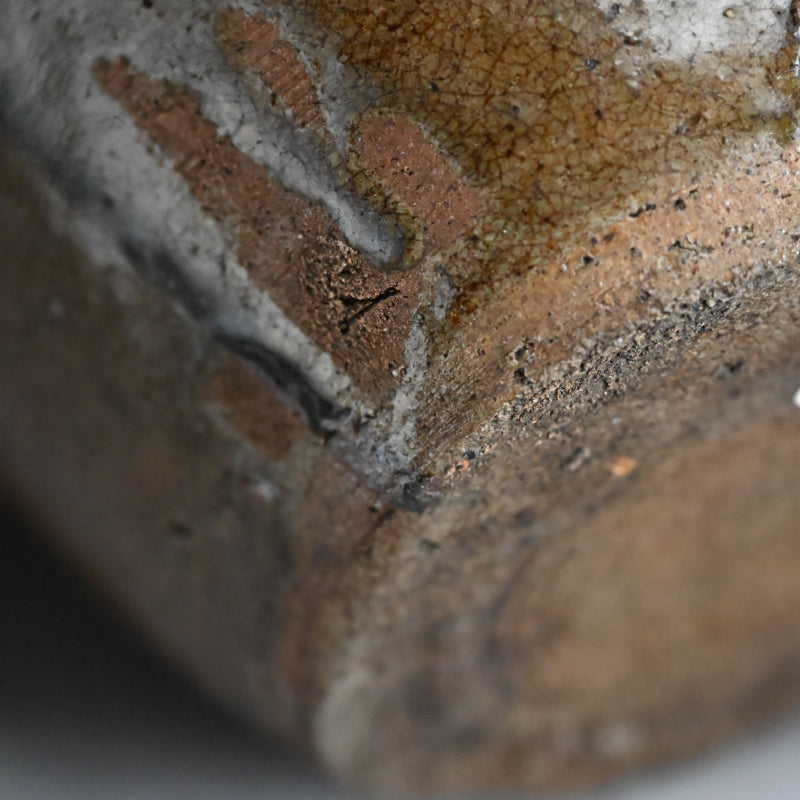
An Edo period Tamba seed jar re-purposed as a Mizusashi fresh water jar for use in the Japanese tea ceremony complete with black lacquered wooden lid and enclosed in a kiri-wood box titled Kotamba Mizusashi. It is 19 cm (7-1/2 inches) diameter, 22 cm (8-3/4 inches) tall and in excellent condition.
Tamba is one of Japan's oldest and most esteemed ceramic traditions, with a history stretching back over 800 years. It originated in the Tamba region, near the present-day city of Sasayama in Hyōgo Prefecture. Renowned for its rustic beauty and utilitarian designs, Tamba pottery played a significant role in the development of Japanese ceramics. Tamba pottery began during the late Heian period, influenced by earlier Sue ware and regional pottery traditions. Initially, it was simple, unglazed, and primarily used for everyday purposes such as storage jars, cooking pots, and water vessels. The introduction of anagama kilns (single-chamber, tunnel-like kilns) during the Kamakura pieriod allowed potters to fire larger vessels at higher temperatures. This resulted in sturdier ceramics and the characteristic natural ash glaze (shizen-yu), where ash from the wood-firing process melted onto the pottery, creating beautiful, accidental patterns. During the Muromachi period, Tamba pottery became more widely distributed and began to incorporate more refined techniques. The natural ash glaze and earthy tones gained favor for their understated aesthetic, aligning with the emerging wabi-sabi philosophy. The rise of tea culture and the influence of tea masters like Sen no Rikyū brought new attention to rustic ceramics. Tamba pottery, with its natural textures and earthy tones, was highly valued for tea ceremony utensils such as tea bowls and water jars. Potters also began experimenting with more decorative techniques, including applying slip and creating more varied forms. Production expanded, and Tamba ware diversified into more ornamental and specialized items while maintaining its utilitarian roots. With the advent of industrialization, traditional pottery faced challenges. However, efforts were made to preserve Tamba pottery as an important cultural tradition. The Mingei (Folk Craft) Movement, led by figures like Yanagi Sōetsu, celebrated the simple beauty of Tamba ware, sparking renewed interest. Tamba became one of the "Six Ancient Kilns of Japan" (Nihon Rokkoyō), a designation highlighting its importance in the history of Japanese ceramics.