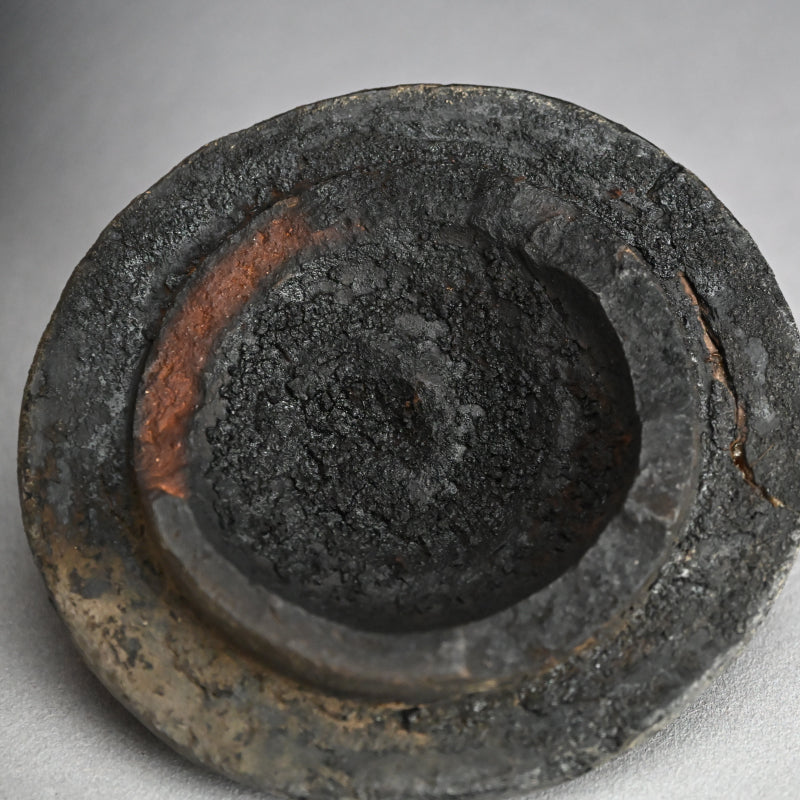
The cutest elephant (piglet?) ever produced, this antique figure is made of thick pale clay, his open mouth and snout coated in black soot from eons of burning incense. On his back a heavy pottery lid, equally blackened inside. The inner rim on the underside of the lid has lost much of its edge, however the lid itself is still perfectly intact. The tip of the right ear has been broken off, and it is likely that there was once some form of tail insert, which is no longer extant. This is evidenced by the lack of smoke around the rump where a smooth, circular hole exists. It is 40 x 21 x 20 cm (16 x 8 x 8 inches), dating from the Edo period.
The elephant is the vehicle for Fugen Bosatsu, the Bodhisattva of Virtue. Also, in Buddhism the elephant is a symbol of mental strength. At the beginning of one's practice the uncontrolled mind is symbolized by a gray elephant who can run wild and destroy everything on his way. Just as the rampaging elephant is controlled by unregulated passions, we often find ourselves ruled by our desires, fears, and resentments. We think that suffering arises from what others do to us, or what happens to us; as self-perceived victims, we suffer. However, after taming one's mind, the mind which has been brought under control is symbolized by a white elephant strong and powerful, who can be directed wherever one wishes and destroy all the obstacles on his way. The Buddha taught that suffering arises internally, from our responses to events. To free ourselves from suffering, we subdue our minds, and with that tamed mind, we answer difficult circumstances without fear, desire, or rage, transforming adversity into growth. As such, the degree to which we experience unhappiness and pain depends on our internal responses, not on external conditions.