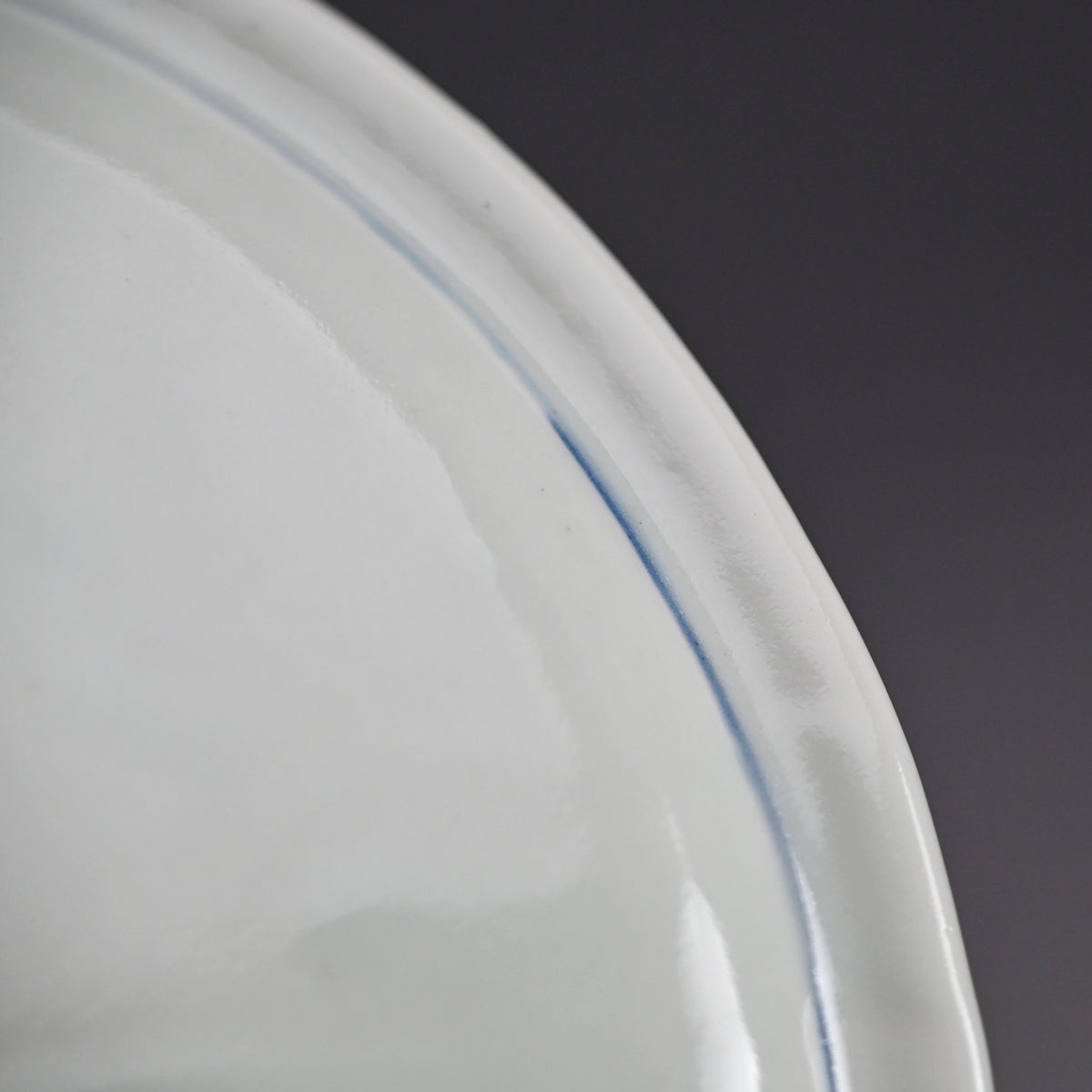
An early blue and white Imari Plate decorated with a view from the top of a lotus flower dial inside of which we find a Suzume resting on a branch of plum blossoms dating between 1630 and 1660. It is 21cm (8-1/4 inches) diameter, 3 cm (1 inch) tall and in excellent condition.
The origins of Japanese porcelain production can be traced to the early seventeenth century, following the arrival of Korean potters in Kyushu after Toyotomi Hideyoshi’s invasions of Korea in the 1590s. Under the patronage of the Nabeshima clan of Hizen Province, these craftsmen introduced advanced ceramic techniques that laid the foundations for porcelain manufacture in Japan. The discovery of porcelain stone in the Arita region, traditionally attributed to the Korean potter Yi Sam-pyeong (Ri Sanpei) around 1616, enabled the production of Japan’s first porcelain, initially decorated with cobalt-blue designs beneath a clear glaze. These early wares, known as Shoki Imari (Early Imari), were named after the nearby port of Imari, through which they were distributed. By the mid-seventeenth century, Japanese potters had mastered overglaze enamel decoration, giving rise to the elegant Kakiemon style and the richly colored porcelains known as Ko-Imari. As political upheaval in China disrupted Chinese porcelain exports, Japanese producers expanded rapidly into international markets, with the Dutch East India Company shipping large quantities of Imari porcelain to Europe from the 1650s onward. During the Edo period, the Hizen region became Japan’s principal center of porcelain manufacture, developing distinctive traditions including Imari, Kakiemon, and the exceptionally refined Nabeshima wares produced for the shogunate. Together, these traditions established Kyushu as one of the great centers of porcelain production, profoundly influencing both Japanese ceramics and European decorative arts.