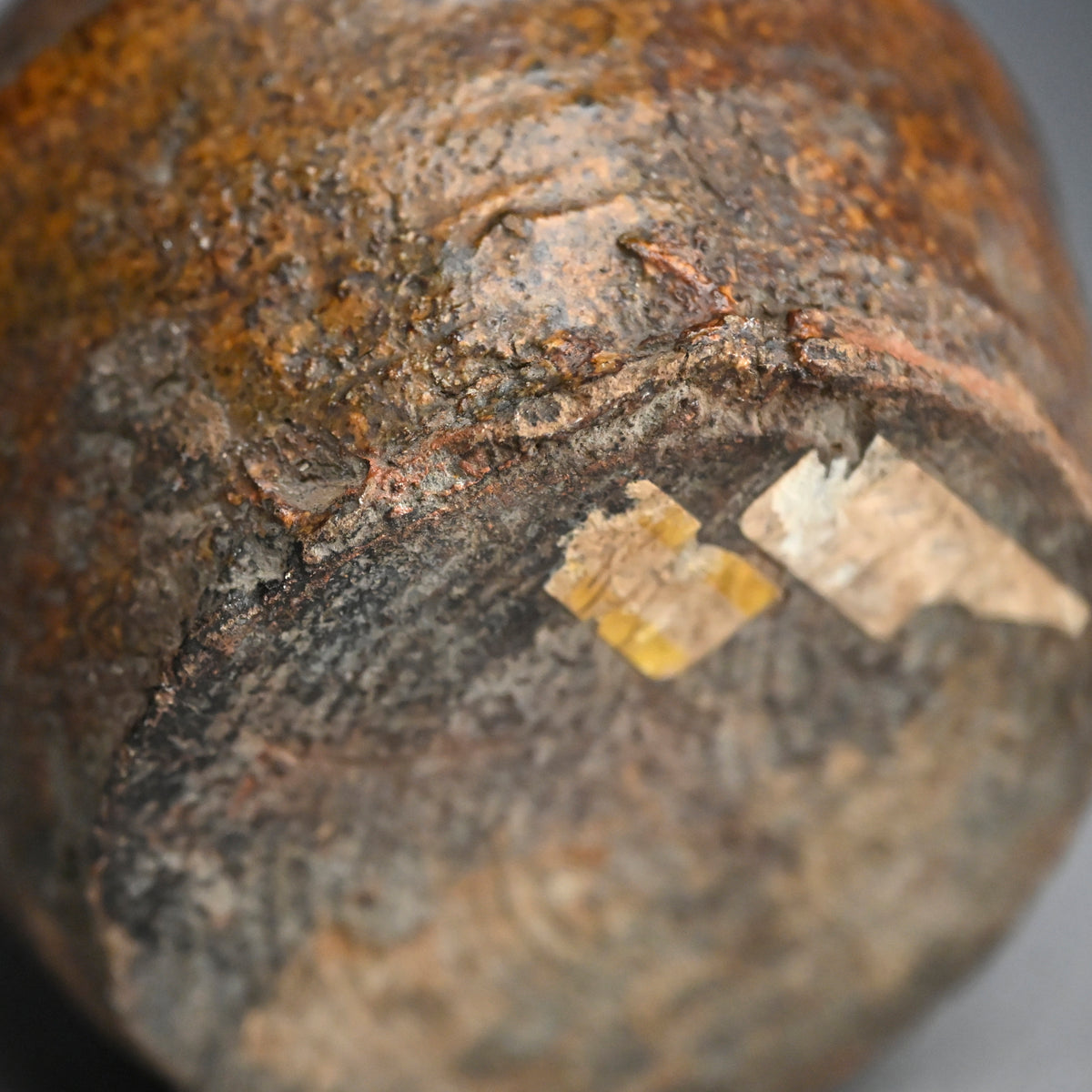
A small Oil jar from the Echizen region dating froth early Edo period, an iron ring run through the small spout to allow it to act as a hanging vase for a tea room setting. Echizen ware is characterized by its simple folk craft-like beauty created by the warmth of its soil, simple and sturdy construction and charm of its earthen glazes. This jar is no exception, the iron rich clay spattered with ocher ash deposits. It is 11.5 cm (4-1/2 inches) diameter, 9 cm (3-1/2 inches) tall. There is a small chips to the rim typical of mingei pottery which has lasted over 300 years.
Echizen ware traces its origins to the late Heian period, when pottery production developed in the hills of present-day Echizen-chō, around the end of the twelfth century. The kilns were influenced by the ceramic traditions of Tokoname, producing sturdy, unglazed stoneware from locally available iron-rich clays. The soil in Echizen contains iron, giving it a high melting point and therefore making it able to withstand high firing temperatures. Due to its high content of glass components such as quartz, which flow in between the soil particles when fired and then solidify, any gaps are filled, resulting in a finish that is hard and dense. During the Kamakura and Muromachi periods, Echizen developed into one of Japan's important medieval pottery centers, later recognized among the Six Ancient Kilns (Rokkoyō). Production concentrated on storage jars (tsubo), mortars and other practical wares. With a large port, maritime trade along the Sea of Japan carried Echizen vessels to markets throughout the Hokuriku region and beyond. Although primarily utilitarian, these wares possessed a distinctive aesthetic character: robust forms, vigorous throwing marks, and surfaces transformed by the unpredictable interaction of flame, ash, and clay. By the late Muromachi and Sengoku periods, Echizen had reached its greatest prosperity. Large kilns, some exceeding twenty-five meters in length, were capable of firing enormous quantities of pottery, supplying the expanding markets of medieval Japan. Although it remained relevant as a pottery center, production declined in the early Edo period. Although conceived primarily as practical vessels, medieval Echizen ceramics are now admired for their powerful simplicity and the uncontrived beauty of their surfaces.