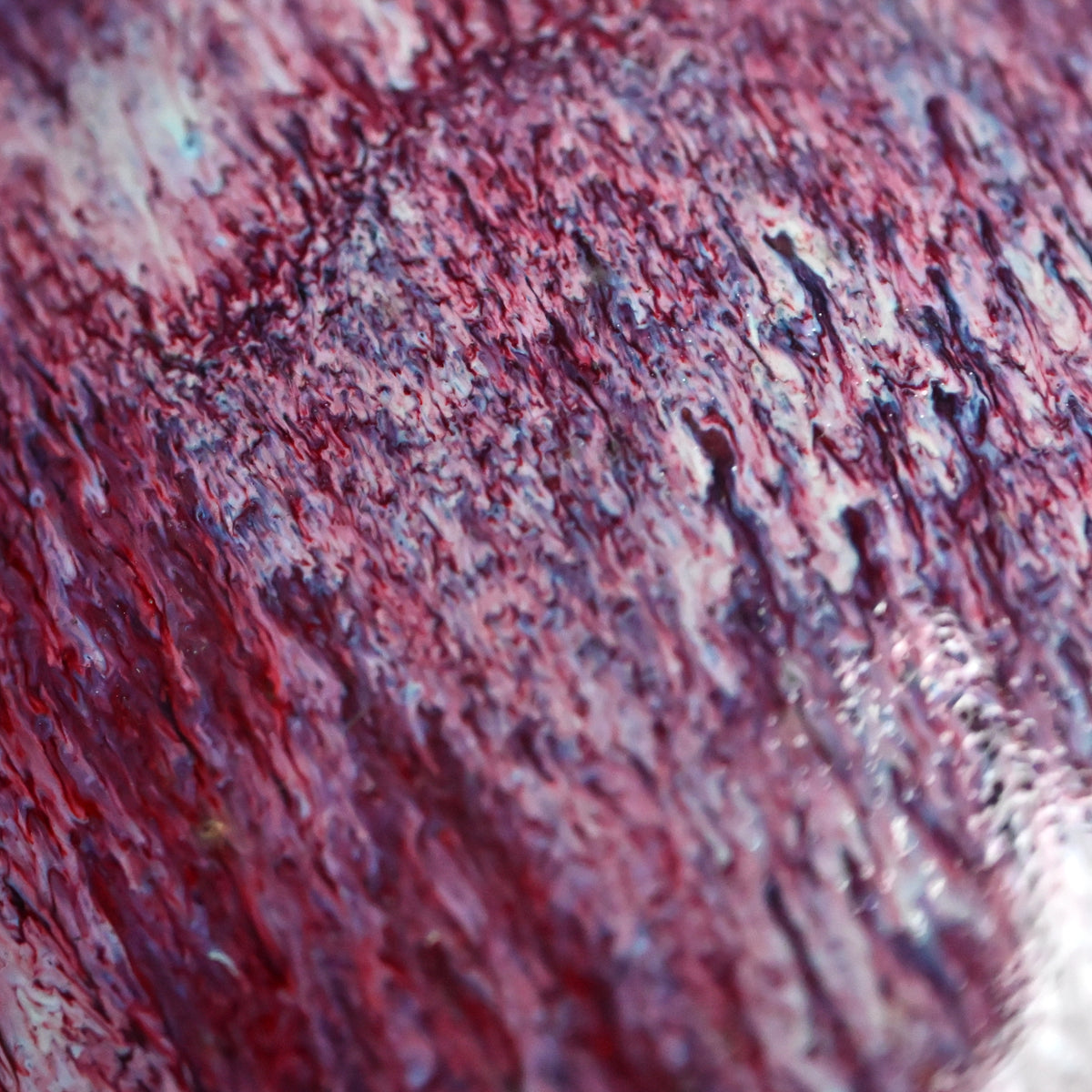
A spectacular form emblazoned with pink flambe glaze sporting a band of creatures in raised relief about the shoulder dating from the early 20th century kilns (Taisho to early Showa eras) of Kyoto. It is 17.5 cm (7 inches) diameter, 34.5 cm (14 inches) tall and in excellent condition, enclosed in a custom made wooden storage box.
The emergence of Shinsha, copper-red or flambé-type glazes, in the early twentieth century belongs to the transformation of Kyō-yaki from an inherited craft tradition into modern studio ceramics. Japan knew shinsha earlier, but it became a major field of experimentation around the Taishō period. Until the late nineteenth century, much of Kyō-yaki's identity rested upon decoration. Around 1900, however, an increasingly important group of Kyoto ceramicists began treating the glaze itself as the principal artistic expression. Shinsha was exceptionally well suited to this new aesthetic because it is notoriously difficult to control. One institution stands right at the center of the story: the Kyoto Municipal Ceramic Research Institute, founded at Gojōzaka in 1896. Its purpose was partly industrial—to modernize Kyō-yaki and make Kyoto ceramics competitive domestically and internationally—but it became an extraordinary laboratory for ceramic chemistry. Researchers systematically investigated clays, firing, glaze chemistry and pigments, while the affiliated training school educated a generation of important twentieth-century ceramicists. The institute's early director Fujie Eizō had already devoted himself to research into Shinsha glaze during his time at the Tokyo Technical School. Scholarship on the Kyoto institute specifically identifies Shinsha as one of Fujie's major research interests and notes his firsthand investigation of Chinese ceramics following his 1898 visit to Qing China. The color depends upon relatively small quantities of copper and upon maintaining appropriate reducing conditions in the kiln. Changes in atmosphere, temperature, glaze thickness, cooling and the underlying body can produce radically different results. So here was a glaze that brought together two seemingly contradictory ambitions of modern Japanese ceramics: scientific control and the beauty of kiln unpredictability (Yohen). The glaze migrated from being evidence of technical mastery to becoming a means of artistic expression.