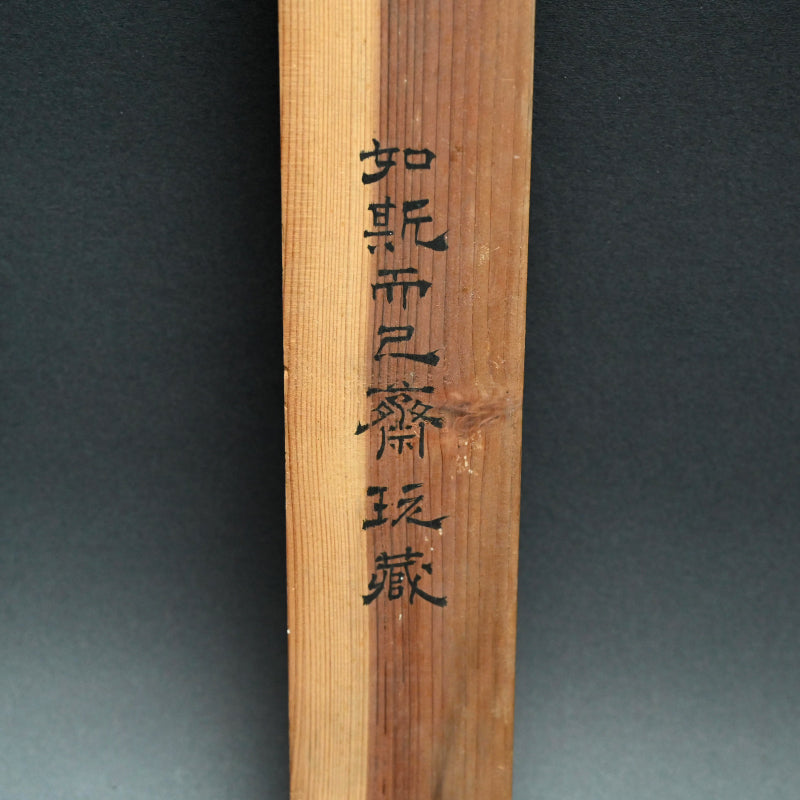
A family rests from their labors under the willow trees on this delicate landscape emulating the tradition of the great 19th century literatus Tanomura Chikuden by Kimura Seiun. A long verse in subtly articulated characters scrolls down the right side. Ink and light color on paper in a green silk border with pale piping featuring hard-wood rollers. The scroll is 48 x 197 cm (19 x 77-1/2 inches) and is in overall fine condition, enclosed in a wooden box.
Kimura Seiun (1885–1967) was a Japanese literati painter active from the late Meiji through the Showa period, celebrated for his serene and refined landscapes rooted in the bunjin tradition. Born in 1885 in Yasugi, Shimane Prefecture, as the second son of Hara Chozo, a local draper, he was originally named Renzaburo before later being adopted into the Kimura family. Showing an early affinity for art, he practiced crest-painting for his family's business before receiving support from local patrons in 1921 to pursue formal artistic training in Kyoto. There he studied under Miyazaki Chikuso and adopted the art name Seiun. Soon afterward he moved to Tokyo to apprentice with Komuro Suiun, one of the leading literati painters of the time, and in 1930 achieved his first acceptance into the 10th Teiten (Imperial Art Exhibition). He continued to be selected for both the Bunten and Teiten exhibitions, and in 1934 established a residence in Tamagawa. Preferring independent artistic practice to the competitive exhibition system, he subsequently traveled widely throughout Japan, deepening his study of nature and holding solo exhibitions based on the works produced during his travels. In 1953 he altered the first character of his art name, and thereafter frequently returned to his native region, presenting solo exhibitions in Yasugi, Izumo, and Matsue. Kimura died of natural causes in 1967 at his daughter’s home in Tokyo at the age of eighty-two. Deeply admiring the Edo-period master Tanomura Chikuden, he cultivated a lyrical, gentle, and lucid mode of landscape painting that earned him recognition as a distinguished modern inheritor of the literati style.