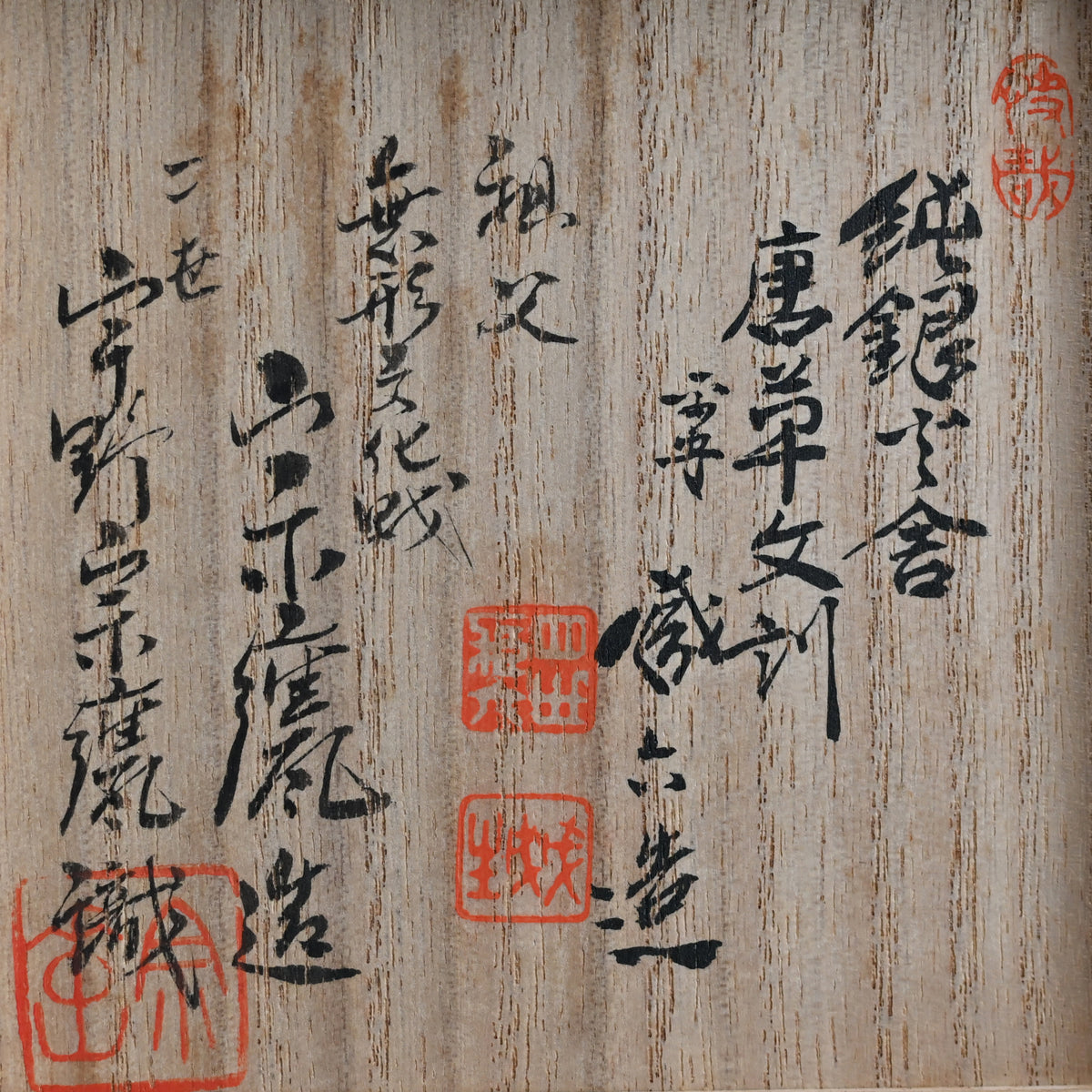
A traditional Shaped censer known as a Chidori Koro in Japanese by distinguished potter Uno Soyo complimented with a Silver lid pierced with Karakusa vines by Hata Zoroku enclosed in a wooden box signed by the metal artist and endorsed by the second generation Uno Soyo. The pottery body is roughly 10.5 m (4-1/8 inches) diameter, 9.5 cm (3-3/4 inches) tall and is in perfect condition, along with the silver lid. The box was initially made for the inense burner, and was extended to accept the addition of the exquisitely worked lid.
Uno Sōyō (1888–1973), born Uno Sōtarō in Kyoto, was a distinguished ceramic artist celebrated for his mastery of sophisticated glaze techniques, particularly shinsha (copper-red glaze) and celadon. After studying at the Kyoto Municipal Ceramic Testing Station, he developed a matte glaze in the late Meiji period and subsequently devoted himself to researching copper-red, Jun ware, celadon, and tenmoku glazes. In 1937, he succeeded his father as the second-generation Uno Jinmatsu, relinquishing the name to his younger brother in 1942 and thereafter working as Sōyō. His achievements were recognized in 1952, when his copper-red glazing technique was selected as an Intangible Cultural Property, followed by the official documentation of his celadon techniques in 1957. He exhibited regularly at the Japan Traditional Art Crafts Exhibition and became a full member of the Japan Kōgei Association in 1955. The censer is complemented by a silver lid believed to have been made by Hata Zōroku II, successor to the distinguished Kyoto metalworking lineage established by the first Hata Zōroku during the late Edo period. The original master trained at the celebrated Ryūbundō workshop and became renowned for his study of ancient Chinese bronzes, receiving prestigious commissions from the imperial household and Tokugawa shogunate. His successors continued this tradition of refined metal casting, making the combination of Sōyō's ceramic artistry and Zōroku's metalwork a particularly harmonious expression of Kyoto's distinguished craft heritage.