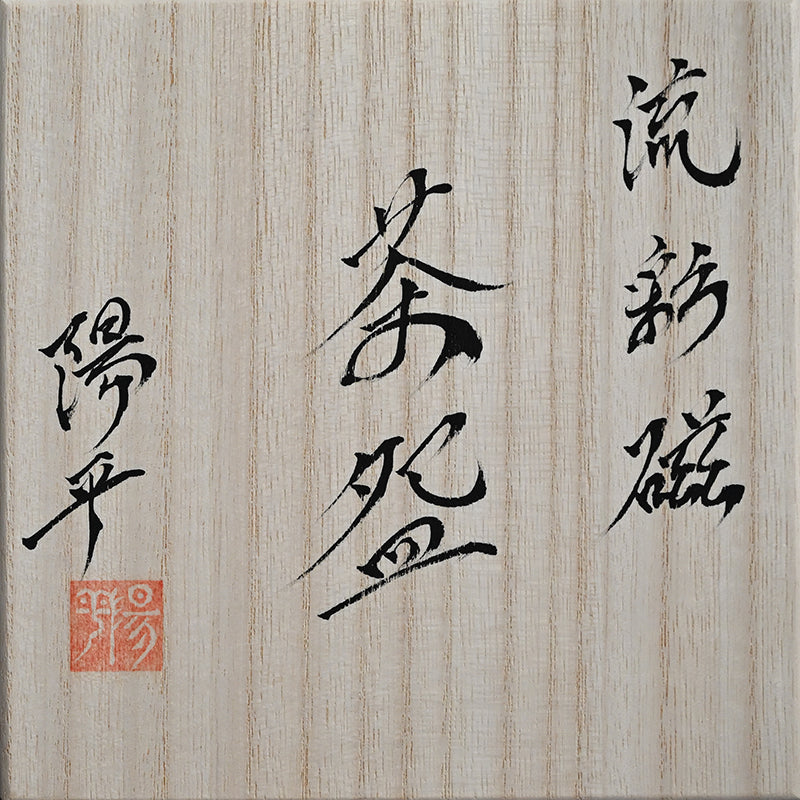
Quietly luminous in surface and restrained in form, this porcelain tea bowl by Nagakusa Yohei demonstrates the artist’s sensitivity to both functional proportion and the expressive movement of glaze. It comes enlosed in the original signed wooden box titled Ryūsai-ji Chawan. The vessel’s rounded body is subtly articulated with vertical fluting that guides the descent of glaze during firing. From the pale, ivory-white rim the surface gradually deepens into cool tones of blue and indigo that gather toward the base, while the interior reveals an even darker pool of color at its center. This gentle transition of tone evokes the visual sensation of depth—like looking into still water whose color darkens as it recedes. The smooth, unbroken rim and softly curved profile provide a calm counterpoint to the rhythmic structure beneath the glaze, allowing the vessel to sit comfortably in the hands while maintaining a refined sculptural presence. Balancing technical precision with the quiet fluidity of kiln-born effects, the bowl reflects Nagakusa’s exploration of light, depth, and movement within porcelain. The work measures approximately 12.5 cm (5 inches) in diameter and 8.2 cm (3-1/4 inches) tall, in excellent condition, acquired directly from the artist.
Nagakusa Yohei was born in Aichi prefecture in 1986. He studied Mechanical Engineering and design in University, and worked for several years in that field before turning to ceramics. He graduated from the Tajimi Ceramics Research Facility in 2014, and was awarded that same year special prize at the Mino Ceramic Art Exhibition as well as being first accepted into the Nihon Dento Kogeiten (National Traditional Crafts Exhibition). He states “Glaze, light, and color are central themes in my work. For this exhibition, I have focused primarily on my ryūsai pieces, which I have been making for the longest time. In ryūsai, several types of fluid glazes are applied separately. During firing, the glazes flow and melt into one another, forming gradients of color. While I control the flow to a certain extent, the final result is entrusted to the firing process, and it is precisely this balance of difficulty and appeal that draws me to the technique. Another element I value deeply is form. I study time-honored shapes and continue to pursue forms that allow both beauty of proportion and the natural movement of glaze to be fully expressed”.