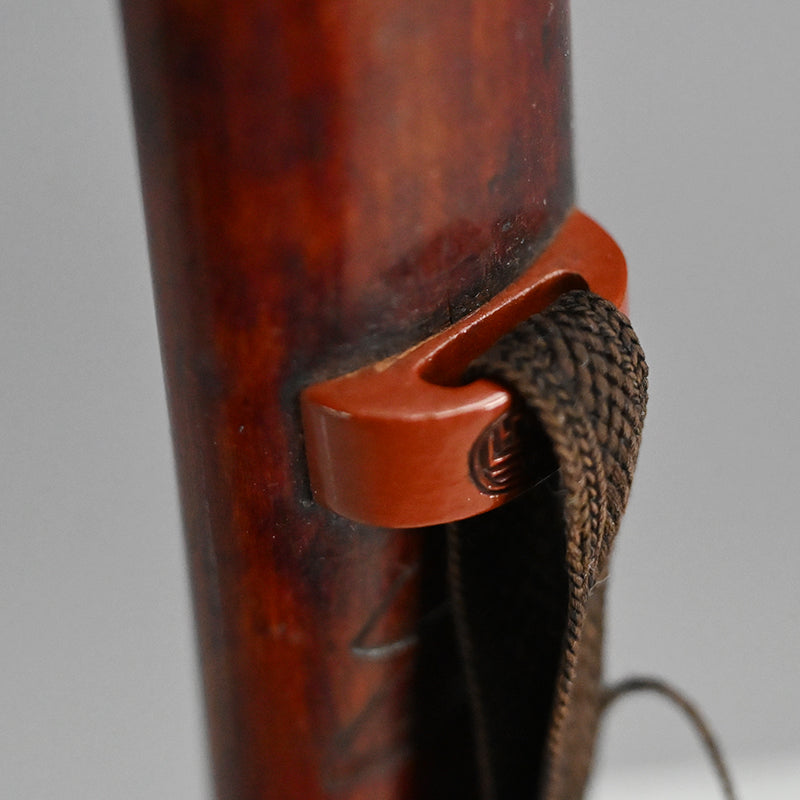
A wooden sword by important artist Tamakaji Zokoku carved in the Sanuki tradition with flowering water plants and a dragonfly about the scabbard, a bat and auspicious reishi mushrooms on the handle, with the artists seal carved neatly into the Kurigata which holds the tie chord. It is 47.5 cm (19 inches) long and in excellent condition.
In Japanese martial culture, dragonflies (often called Katsumushi, or "victory insects") symbolized courage, agility, and unwavering resolve. Samurai warriors revered them because they move only forward, which served as a fierce talisman of an invincible warrior spirit, never retreating in combat. Because of these profound associations, the dragonfly motif became a staple in traditional Japanese martial design. Bats symbolize happiness and luck. This is largely due to Chinese cultural influence, where the word for bat (fu) sounds identical to the word for good fortune. Reishi mushrooms (Ganoderma lucidum) are famously known in East Asian traditions as the "Mushroom of Immortality" and the "Divine Fungus." They symbolize longevity, good fortune, spiritual potency, and peace. Historically so rare in nature, they were initially reserved exclusively for emperors, royalty, and nobility.
The production of lacquer-ware in Kagawa (Shikoku) was encouraged by the feudal lord Yorishige Matsudaira (1622-1695) and many artisans took up residence in the area. Tamakaji Zokoku was an important artist in the development of modern Kagawa lacquer art. Born in Takamatsu City, Kagawa, in 1806, at a young age he went to Kyoto where he studied painting as well as lacquer technique. Zokoku was granted access to many important collections of antique lacquer works including works from countries such as China, Thailand, and Myanmar in the possession of Higashi-Honganji Temple and Daitokuji Temple. After returning to Takamatsu his talent was recognized by Matsudaira Yorihiro (ninth lord of the Takamatsu Domain), and he was appointed to manage the items in the domain's treasury. He carefully researched each of these treasures to further develop his own skills. He established a distinctive style of lacquer-ware based on his interpretation of these traditional techniques. Today, these form the basis of the three major Kagawa Lacquer ware Techniques, Kinma, Zonsei, and Choshitsu.