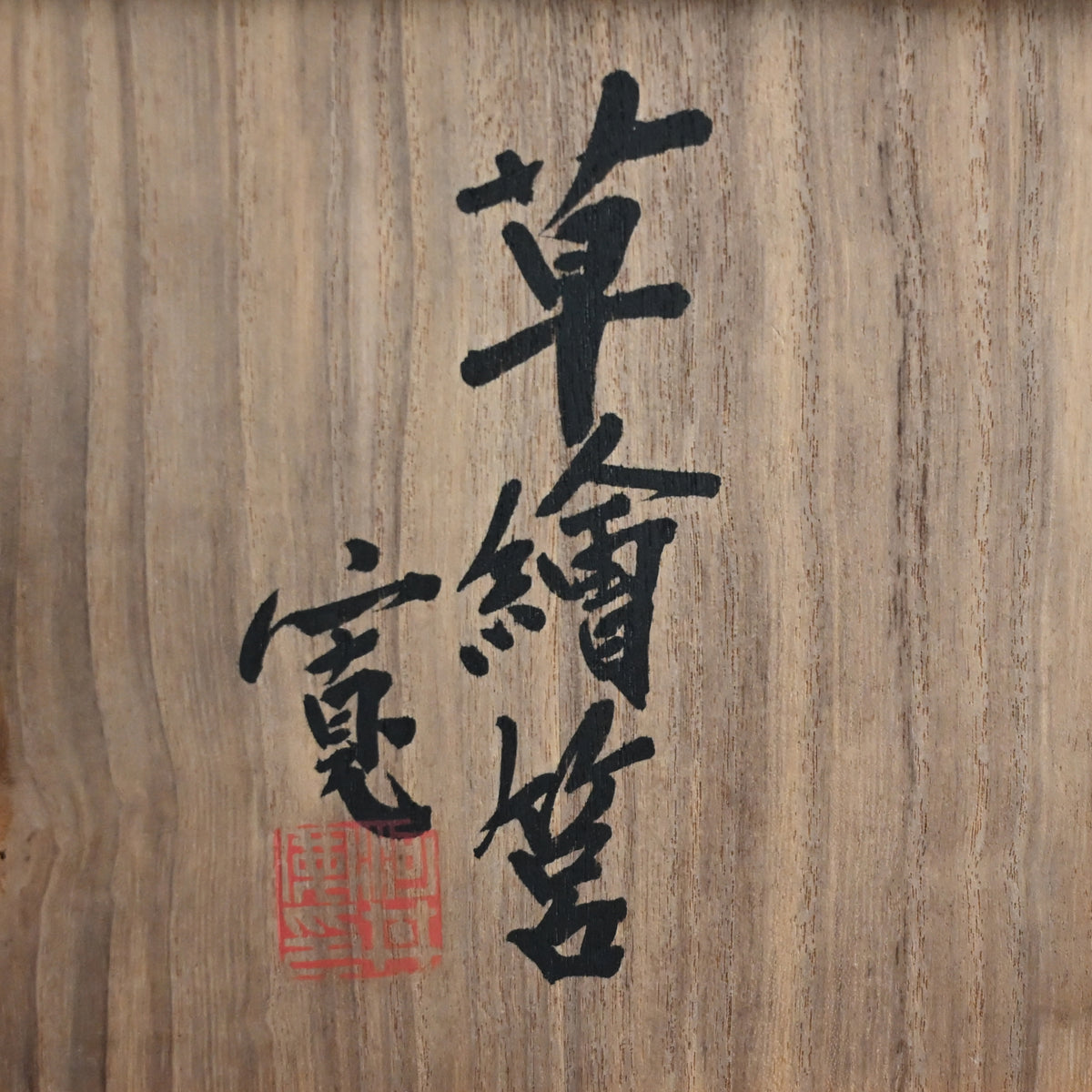
A superb covered ceramic box by Kawai Kanjiro enclosed in the original signed wooden box titled Kusa-e Bako (Box with Grass Design). Strongly architectural in form, the square body rises from a subtly recessed foot to support a gently undulating lid whose corners lift almost imperceptibly, softening the otherwise severe geometry of the piece. Both body and lid are enveloped in a lustrous iron-rich glaze of extraordinary depth, appearing nearly black in places before warming toward translucent amber and golden brown along the edges and ridges. Across the lid Kanjiro has painted a wonderfully spontaneous design of grasses, their sweeping stems and broad leaves rendered in rust red, creamy white and small accents of pale blue-green. The decoration seems almost to float within the dark glaze, the loosely brushed forms possessing the directness and vitality of calligraphy rather than conventional ceramic ornament. Particularly beautiful is the relationship between the heavily glazed exterior and the quiet, milky-white interior, a contrast revealed only when the box is opened. The slight irregularities of the walls, lid and rims are equally important: despite its geometric conception, nothing has been allowed to become mechanically precise, leaving the presence of the maker's hand evident throughout. This balance between disciplined form, vigorous brushwork and richly responsive glaze is characteristic of Kanjiro at his finest, transforming an ostensibly simple covered box into an intimate meeting of painting, pottery and utility. It measures 20.5 x 19 cm (8-1/8 x 7-1/2 inches) and stands 14.5 cm (5-3/4 inches) tall, in excellent condition.
Kawai Kanjiro (1890–1966) was one of the defining figures of modern Japanese ceramics and, together with Hamada Shoji and Yanagi Soetsu, a central force in the development of the Mingei movement. After graduating from the Tokyo Higher Technical School, where he studied ceramic chemistry and kiln technology, Kawai moved to Kyoto and in 1920 established his workshop at Gojozaka, now preserved as the Kawai Kanjiro Memorial Museum. His early work displayed a remarkable command of Chinese and Korean ceramic traditions, but during the 1920s his encounter with Yanagi, Hamada and the emerging philosophy of Mingei profoundly redirected his work toward the beauty of everyday objects and the expressive possibilities of materials and process. An extraordinarily inventive glaze researcher, Kawai developed a distinctive vocabulary of iron, copper-red, cobalt, lead and other richly colored glazes, frequently combined with vigorous brushed or wax-resist decoration. His creativity extended far beyond pottery to woodcarving, sculpture, poetry, calligraphy and writing, all understood as aspects of a single creative life. Although widely recognized as one of Japan's greatest twentieth-century potters, Kawai avoided official honors and never signed his mature works, believing that the object rather than the reputation of its maker should command attention. He was considered for designation as a Holder of Important Intangible Cultural Property—popularly known as a Living National Treasure—but declined participation in the designation process, an attitude entirely consistent with his resistance to individual celebrity.