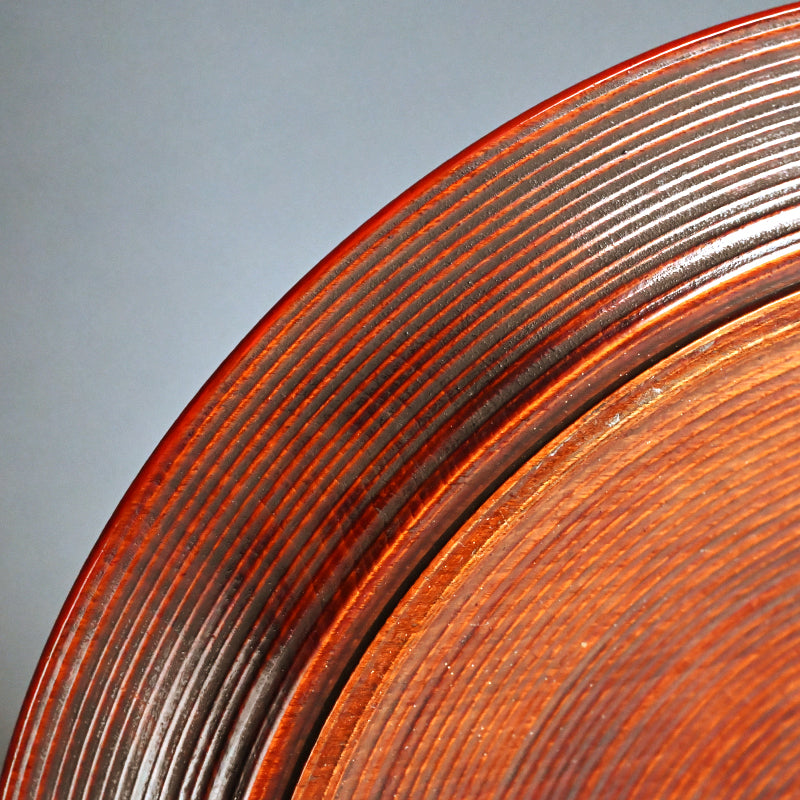
Auspicious fruits and seasonal delicacies buried in green leaves circle the rim of this exceptional carved and lacquered wooden tray by Mori Zodo of the Sanuki-bori tradition. Lotus root, peaches, red peppers and green beans, ginger root, Buddhas hand Fruits and persimmons all compete for space. The tray is signed on the reverse among the concentric rings left by the cutters knives. It is 38 cm (15 inches) diameter, 3 cm (1 inch) tall and in perfect condition, dating from the pre-war era.
Mori Zodo (1887-1967) was a distinguished lacquer artist from Takamatsu in Kagawa Prefecture and a master craftsman of Sanuki-bori carving and Sanuki lacquer tradition trained under Kajikawa Zokoku. His works are held in public collections such as the Takamatsu City Museum of Art.
The history of Sanuki carving and lacquer is rather unique within Japanese lacquer. Unlike Kyoto maki-e or Wajima lacquer, it is fundamentally a sculptor's tradition rather than a painter's tradition. The carved surface is the primary artistic expression, while lacquer serves to enrich, preserve, and animate the carving. The foundations were laid in the Takamatsu Domain (present-day Kagawa Prefecture) during the Edo period. The first lord of the domain, Matsudaira Yorishige (1622–1695), grandson of Tokugawa Ieyasu, was an enthusiastic patron of the arts. His support encouraged lacquer production in Sanuki, although the characteristic style had not yet emerged. The true founder of Sanuki lacquer was Tamakaji Zokoku (1806–1869), a craftsman of extraordinary curiosity and technical ingenuity. Rather than merely imitating Japanese traditions, Zōkoku studied imported Chinese carved lacquer and Southeast Asian lacquerware, particularly Burmese and Thai techniques. From these diverse sources he developed a distinctly Sanuki vocabulary based on three principal methods; Kinma engraved lines filled with colored lacquer, Chōshitsu carving directly into thick layers of built-up colored lacquer and Zonsei painted lacquer designs enhanced by delicate engraved lines. These became the defining techniques of Sanuki lacquer. During the Meiji period the elaborate Zonsei technique proved too labor-intensive for commercial production and gradually disappeared. In its place arose Sanuki-bori—deeply carved wooden objects coated with colored lacquer.