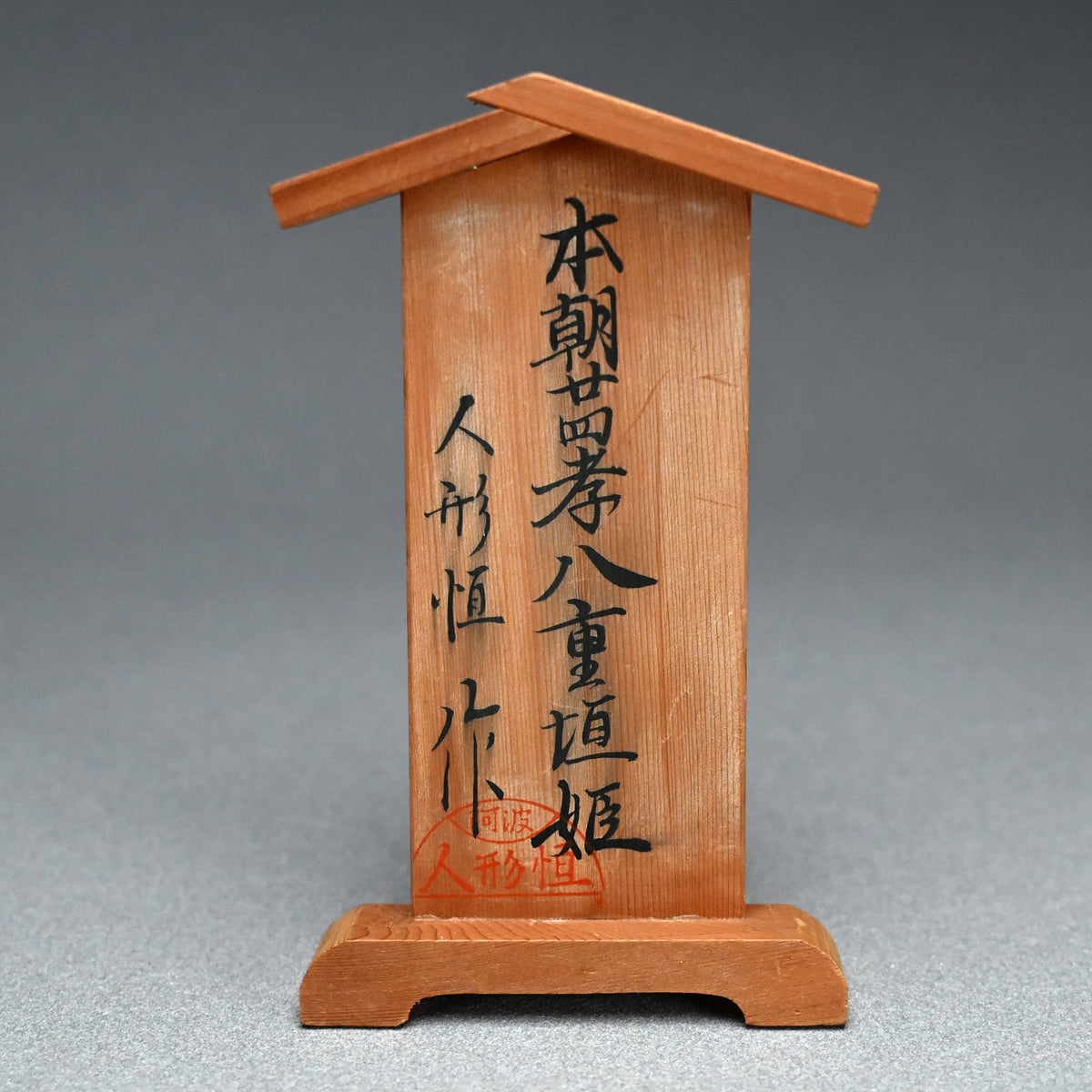
A Bunraku puppet head (kashira) representing Yaegaki-hime, the celebrated heroine of the 1766 ningyō-jōruri drama Honchō Nijūshikō by Tamura Tsuneo, one of the great modern Bunraku and Awa Puppet makers singed on the neck with an impressed brand Awa Ningyo Tsune. The head is 18.5 x 21 x 44 cm (7-1/2 x 8-1/2 x 17-1/2 inches) including the stand and comes with a signed wooden placard identifying the character and artisan. Awa refers to the distinctive puppet tradition of Awa Province, present-day Tokushima. This is related to Bunraku, but I would not simply call the object a “Bunraku puppet.” Awa Ningyō Jōruri developed its own exceptionally important regional tradition, with distinctive puppet makers, heads (kashira), performance practices and rural puppet theatres. This is not an antique head in the Edo/Meiji sense, but a modern work made within the living Awa puppet tradition using techniques transmitted through the restoration and study of historic Awa kashira. That grant the head a very specific lineage connecting the modern craftsman to masters such as Tenguhisa and Ningyōtomi.
One of the great princess characters of the traditional theatre, Yaegaki-hime is famed for the “Fox Fires in the Inner Garden” scene, in which her devotion to Takeda Katsuyori summons the supernatural power of the fox spirits of Suwa, enabling her to cross the frozen lake to save him.
Tamura Tsuneo (1926–2009), was the teacher of Amari Yōichirō. In 1982, Tamura Tsuneo, while serving as head of the Awa Dekō Production Preservation Society), accepted the restoration of 39 puppet heads that had been damaged in a fire in Ehime. These included works by important earlier Awa masters such as Tenguhisa I, Tenguben, Ningyōtomi, Ningyōchū, and Ningyōtomo. Ningyō Tsune, Ningyō Yō and three other craftsmen worked on the restoration, and the source specifically notes that through the process they were able to study the techniques of these earlier masters.