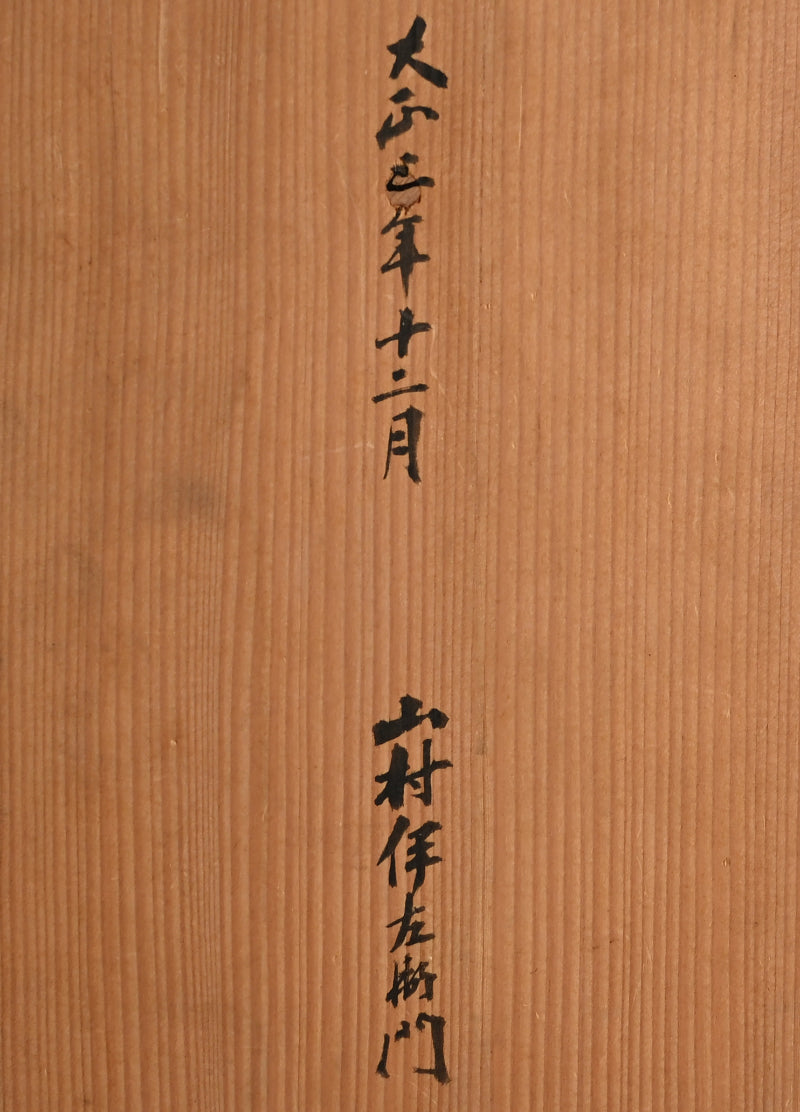
Imperious designs decorate the swelling body and trumpeting rim of this elegant Satsuma vessel dating from the early 20th century enclosed in a custom made wooden collectors box titled Satsuma-yaki Kabin and dated the 12th month of Taisho 3 (1914). It is 17.5 cm (7 inches) diameter, 30 cm (12 inches) tall and in excellent condition, signed on the base Kozan in a green cartouche.
The history of Satsuma ware goes back to the 16th century when Japan fought in the Imjin War, (also known as the Porcelain War), in which Yoshihiro Shimazu, Lord of the Satsuma domain, brought back eighty Korean potters, giving birth to a new ceramic tradition on Japanese soil. There are four main historical lines of Satsuma ware: Tateno, Ryumonji, Naeshirogawa and Hirasa. They are roughly separated into white wares, black wares and porcelains. Kuro Satsuma (black ware) is made by using combinations of black or brown colored glaze. The body itself is dark brown since the clay contains iron from the local soil enriched by the volcanic ash of Sakurajima.
Although no known date exists, Satsuma potteries are believed to have begun during the late 16th century when Korean potters were brought to Japan, jumpstarting the ceramic industry in Kyushu, from the Naeshirogawa area, which were to become the hub of the local pottery industry. The oldest remaining examples of Satsuma are stoneware made from iron-rich dark clay covered in dark glaze, humble articles of folk-ware intended for the subdued confines of the tea room of practical everyday use in largely rustic environments. It was not until the early 19th century that the bright and golden works known now as Satsuma began to be created, if not mostly for the export market.