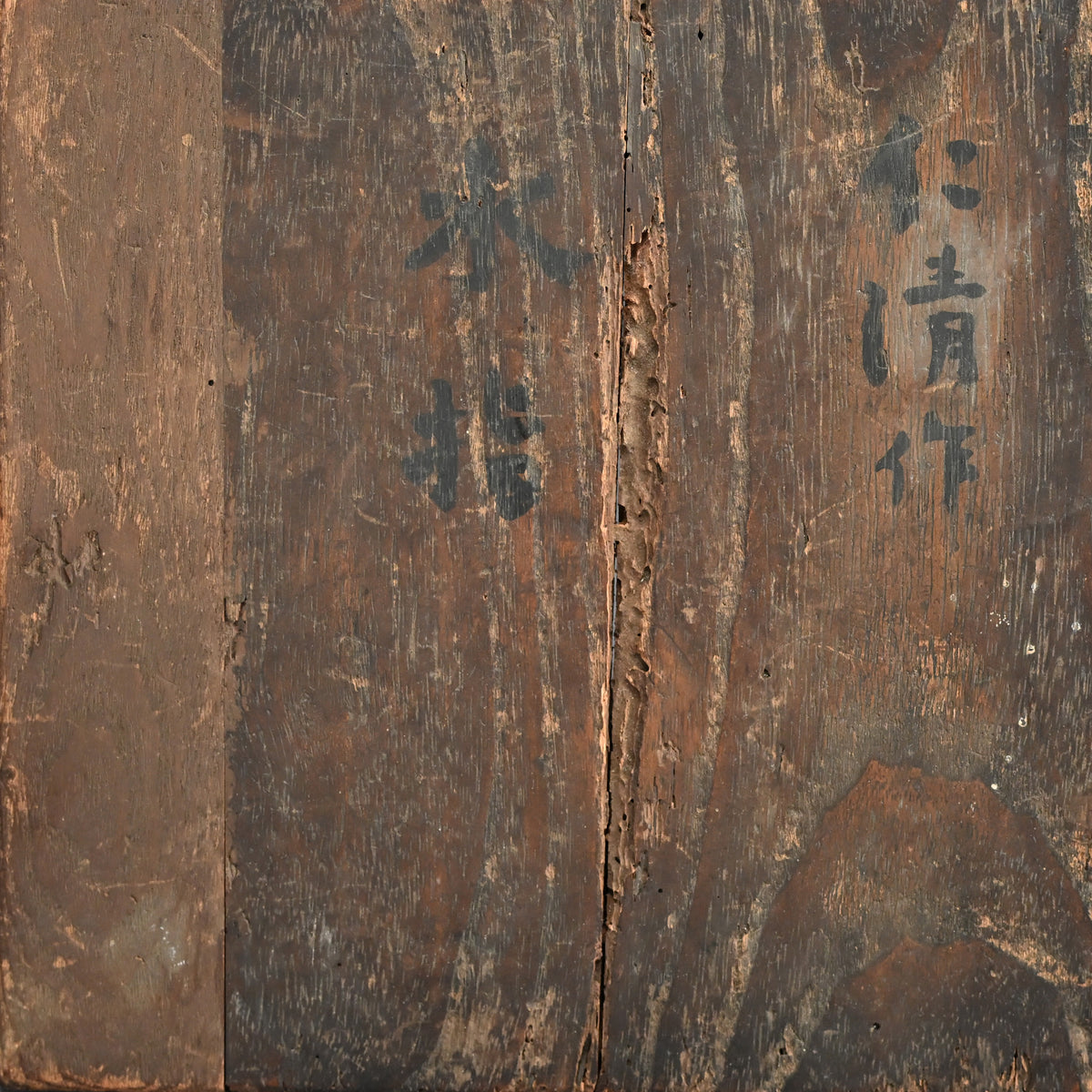
A 19th century freshwater jar for use in the Japanese Tea Ceremony, the earthenware body covered in aka-e red, yellow and green designs with highlights in gold enclosed in a period wooden box titled Ninsei Mizusashi. Dating from the later 19th century, it is stamped on the base Ninsei. The flat top has Kanyu (firing cracks) in the glaze, and a small crack extending from the rim. The vessel is 21 cm (8-1/2 inches) square, 13 cm (just over 5 inches) tall and in overall fine condition.
Ninsei refers both to the historical potter Nonomura Ninsei and, more broadly, to an enduring ceramic style or tradition. In the latter sense, the “Ninsei style” became one of the principal decorative languages of Kyō-yaki and has continued, with many transformations, into modern Kyoto ceramics. Its basic vocabulary derives from Ninsei's seventeenth-century innovations: a relatively refined ceramic body covered with a smooth glaze, providing a pale ground upon which decoration could be applied in overglaze enamels (iro-e), frequently supplemented with gold and sometimes silver. Painting rather than the raw character of the clay becomes a major vehicle of expression. The characteristic effect is consequently quite different from something like Shigaraki or Iga. With those wares, clay, fire, ash and accident largely create the visual drama. With Ninsei-style Kyō-yaki, the fired vessel becomes something closer to a three-dimensional ground for painting. Flowers, grasses, birds, waves, clouds, landscapes, courtly motifs and seasonal subjects could spread across the ceramic surface. Gold might be used sparingly as an accent or lavishly to create an almost lacquer-like richness. During the eighteenth and nineteenth centuries, Kyoto's ceramic world became extraordinarily diverse. The great Kyō-yaki potters—among them Okuda Eisen, Aoki Mokubei, Nin'ami Dōhachi, Eiraku Hozen and others—worked within a culture in which revival and reinterpretation of historical ceramic styles was itself part of artistic practice. Ninsei became one of the established decorative languages from which a sophisticated Kyoto potter could consciously invoke. And these objects occupy a very particular niche within the tea aesthetic. A richly decorated Ninsei-style mizusashi, for example, can function almost as a visual jewel within an otherwise restrained tea room. Imagine a subdued tatami room: mud wall, bamboo, iron kettle, dark lacquer, perhaps a relatively austere tea bowl—and then an iro-e Ninsei water jar decorated with autumn grasses in red, green and gold. Its brilliance is not necessarily contrary to the surrounding restraint. The restraint gives the color power. This is one of the reasons I think the Western shorthand of Japanese tea aesthetics as “wabi-sabi” is so misleading. Tea aesthetics often operate through toriawase—the intelligence of combination. Ninsei provides one of the most important decorative voices available within that combination.
There is another reason Ninsei-style ceramics remained so useful to tea practitioners for centuries: they are exceptionally good at expressing season. A roughly fired tea bowl may carry seasonal feeling through texture or poetic association, but painted ceramics can state it much more explicitly. And then there are motifs associated with particular festivals, poems, famous places and classical literature. So the tea practitioner could select a Ninsei-style object almost as one selects a seasonal poem.