A remarkable Kuro-Oribe tea bowl distinguished by its unusually squared foot, boldly contrasting glazes, and expressive, irregular form enclosed in a fine Kiri-wood box endorsed by Seisai Sōsa, 12th Head of Omotesenke, with an accompanying document dated 1919. The gently rising walls are enveloped in a rich, glistening black glaze, interrupted by a broad white reserve decorated with freely painted black geometric patterns of concentric squares and dashes reminiscent of the Ko-doke (Incense clock) pattern. To the right an almost circular passage of matte reddish-black extends over the rim, suggesting a full moon emerging against the darkness of the night sky. The interplay of glossy and matte surfaces, geometric decoration, and subtly distorted form is characteristic of the adventurous aesthetic of Oribe ceramics. Measuring 11.5 cm (4-1/2 inches) in diameter and 7.5 cm (3 inches) in height, the bowl bears the poetic name Shōya, which might be interpreted as “A Night Beyond Compare,” an evocative title particularly suited to its dramatic nocturnal appearance. I particularly like the relationship between the bowl's appearance and its name. The reddish-black passage curling over the rim gives the impression of a moon emerging from darkness, while the sharply painted geometric decoration introduces an entirely different visual rhythm. That contrast is one of the most compelling aspects of the piece.
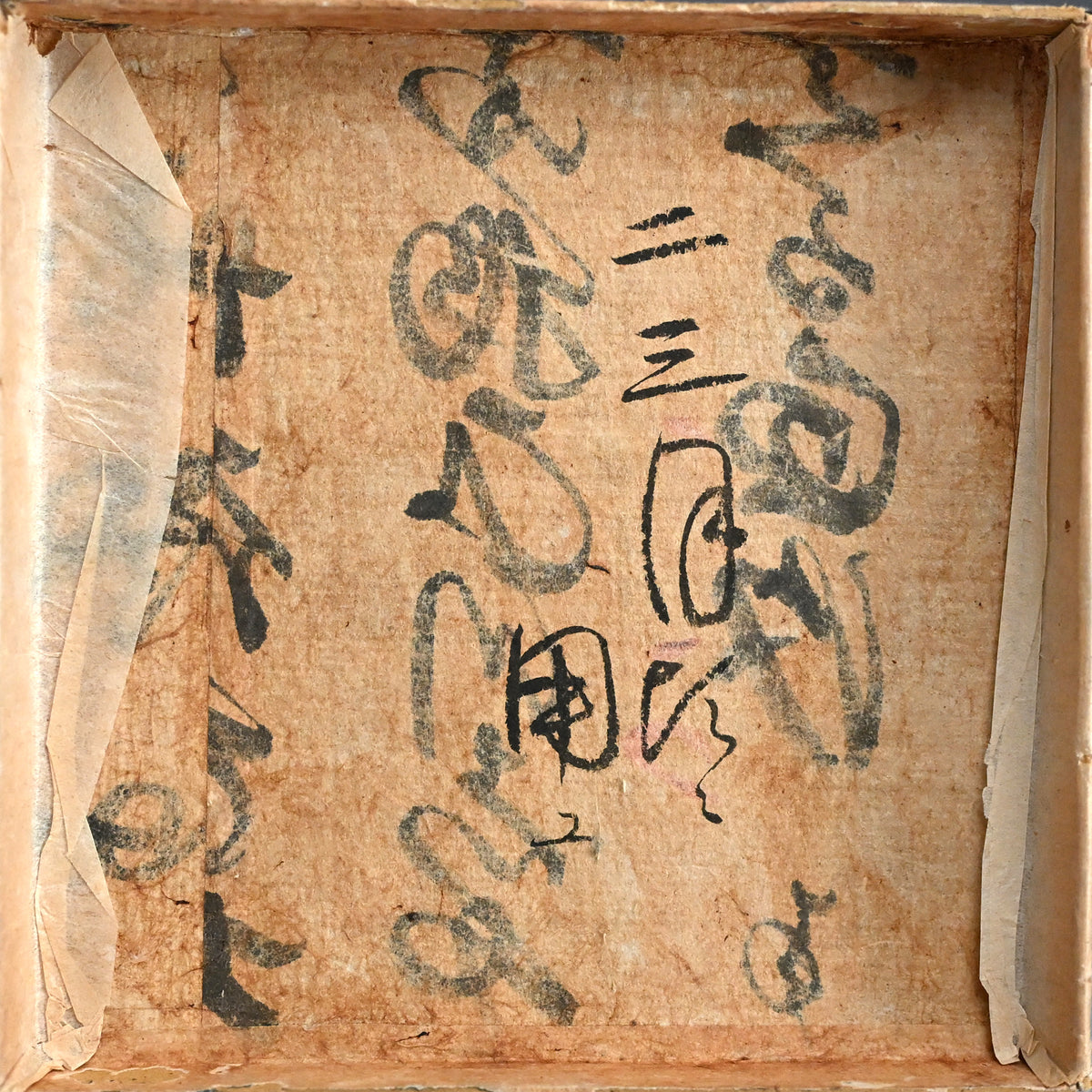
Of particular historical interest is the accompanying wooden box, inscribed by Seisai Sōsa (1863–1937), the twelfth-generation head of the Omotesenke school of tea. Preserved with the bowl is an old handwritten document from Fushin'an, the historic Omotesenke tea establishment, identifying the bowl by its name, Shoya. Dated, provisionally interpreted as May 1919 (Taishō 8), the document appears to acknowledge receipt of a payment associated with the box inscription. Together, the inscription and accompanying receipt provide a valuable record of the bowl's recognition within the Omotesenke tea tradition in the early twentieth century.
Oribe ware emerged in the Mino kilns during the late Momoyama and early Edo periods, reflecting a new spirit of experimentation in Japanese tea ceramics. Associated with the aesthetic sensibilities of the tea master Furuta Oribe (1544–1615), these wares departed from conventional symmetry through their deliberately altered forms, expressive decoration, and striking contrasts of color and texture. Kuro-Oribe bowls are particularly admired for their lustrous black glazes and boldly painted designs, often juxtaposed with areas of exposed or lighter-glazed clay.