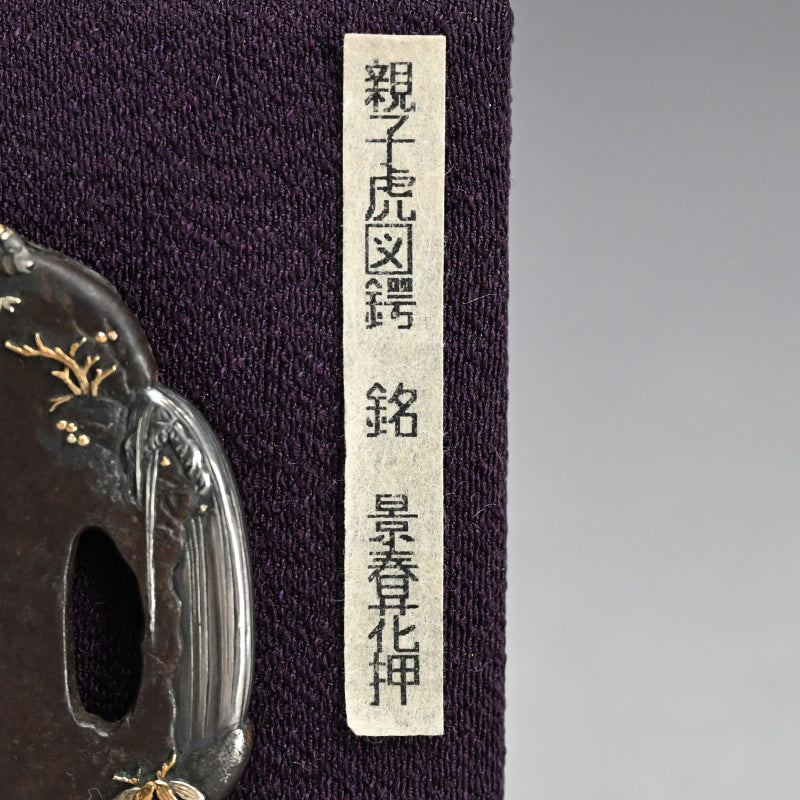
A superb iron tsuba signed Kageharu followed by a Ka-o signature depicting a tiger poised upon the heights above its cub, which clings to the rocky landscape below, the scene continuing around both faces of the guard in finely worked gold, silver and mixed-metal relief. The unusual composition appears to evoke the celebrated legend of shishi no ko-otoshi—the lion casting its cub into a deep ravine, raising only the young capable of climbing back. Long established in Japan as a metaphor for rigorous upbringing. The upper tiger is dramatically positioned above, its body bent downward over the precipice. The smaller tiger is far below on the rocky outcrop. Between them is a torrential waterfall and pine studded precipice. It is very possibly a reference to the famous Japanese legend of a parent casting its young into a ravine (shishi no ko-otoshi). The traditional story says that the shishi casts its offspring into a deep ravine and raises only the cub capable of climbing back. It became a metaphor for subjecting one's child or pupil to severe trials in order to cultivate strength and ability. This is a very appropriate samurai moral metaphor: The parent deliberately subjects the cub to adversity. The ordeal is not abandonment but education: only by overcoming difficulty does the young animal acquire strength. Rather than treating the tsuba merely as a flat decorative plate, Kageharu has conceived it as a continuous miniature landscape wrapped around the sword fitting. Stylistically I would be comfortable placing it broadly in the late Edo period, probably nineteenth century, pending better documentation of the maker. The combination of a dark iron plate with highly pictorial relief work and restrained gold/silver highlights is characteristic of the increasingly painterly approach to sword fittings in the later Edo period. By then the tsuba had long since transcended its purely protective function and become a significant vehicle for miniature metal sculpture. The metalwork is quite sophisticated. The iron ground has been deliberately left comparatively subdued, against which the animals and landscape emerge in relief with what appears to be a mixture of gold and silver inlay or overlay techniques.
It is 6.5 x 5.5 x 0.4 cm (2-1/2 x 2-1/4 inches) and is in overall excellent condition enclosed in a box of shimakokutan (Striped ebony on a crepe-silk pillow with a label reading Tsuba with a fierce tiger design, signed Kageharu. This is likely the Kageharu of the Tanaka School of sword fittings which flourished in the later Edo period, 19th century.