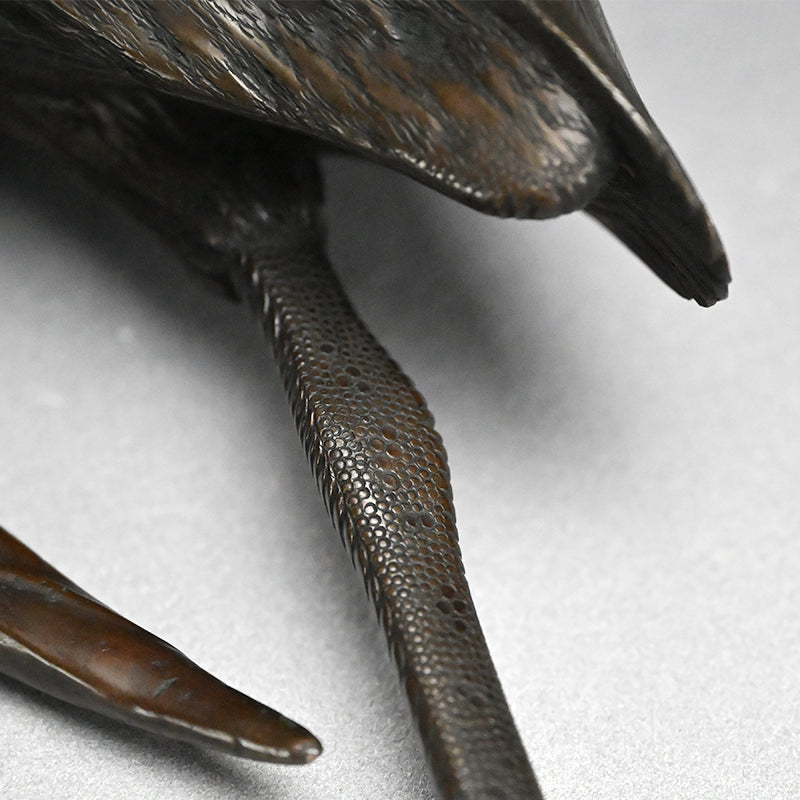
Alert, the egret, perched on a lotus stalk, scans the water surrounding this beautifully cast Meiji period bronze okimono. The figure is 20 x 15 x 45.5 cm (8 x 6 x 18 inches) and is in excellent condition, weighing 3.3 kilograms (7 lbs).
Fine Meiji bronze animal okimono are among the greatest achievements of Japanese sculpture, yet they remain undervalued relative to their artistic importance. Recent scholarship is beginning to challenge the old distinction between "craft" and "sculpture," recognizing that many Meiji okimono deserve to be studied as major works of sculpture rather than merely decorative export objects. f you examine the work of the best artists, especially those from the Kyoto and Tokyo bronze traditions, you see an astonishing synthesis of traditions. The sculptors inherited the observational realism of Buddhist sculpture, the technical sophistication of sword-fittings, centuries of lost-wax casting techniques, naturalistic study inspired by Maruyama-Shijō painting as well as an increasing awareness of European academic sculpture. However, unlike many European bronze sculptors, these artists often focused not on grand heroic narratives but on a single, perfectly observed moment. A crow ruffles its feathers. A crab braces itself against a wave. A tiger pauses before taking another step. These are sculptures about life itself, the moment, rather than drama. The finest bronze crows, eagles, or herons rarely spread their wings dramatically. Instead, they are often shown preening, settling their feathers, or pausing in quiet alertness. That restraint is quintessentially Japanese. It is the visual equivalent of ma—allowing the viewer to complete the action in their imagination. Their greatest achievement is not technical virtuosity, although that is remarkable. It is observation. The sculpture feels alive because it suggests both what has just happened and what is about to happen. The best sculptors never caricature an animal. They seem to understand its character. A monkey is mischievous without becoming comic. A tiger is powerful without becoming theatrical. A crow is intelligent rather than sinister. That sensitivity feels deeply connected to the broader Japanese artistic tradition, where painters from Maruyama Okyo to Nishimuira Goun sought not simply to depict an animal's appearance but to convey its living presence. There are artists whose names alone command premiums, but there are also anonymous or lesser-known makers whose work is simply better than that of more famous contemporaries. The Meiji bronze market has not been studied as intensively as Japanese painting or tea ceramics, so there is still room for connoisseurship in the old-fashioned sense: the ability to recognize quality before looking at the signature.